17-Month-Old Toddler Development and What to Expect

Written by Mindsmaking Medical Writer

Fact Checked by Mindsmaking Professionals
15th, December, 2025
Your 17-month-old toddler is on a non-stop adventure, exploring everything around them. Chasing after them all day may be tiring, but this behavior is a sign of healthy growth and curiosity.
At 17 months, your baby is not just growing, they are blossoming and you can see it in their curious eyes as they explore, hear it in their playful babble as they communicate, and feel it in the way they move around with determination. It is a beautiful mix of discovery, growth, and those tiny moments that melt your heart.
This is the stage where curiosity knows no limits. From climbing, toddling, and poking at everything within reach, your little explorer is constantly testing boundaries. They are proudly showing off their independence, whether by carrying a cup, opening doors, or trying to dress themselves.
Although this stage can feel exhausting, especially with all the constant activity, every new achievement is worth celebrating. Understanding the 17-Month-old toddler development and what to expect helps you stay ahead and enjoy every moment of this adventurous phase.
Key Takeaways
At 17 months, toddlers are rapidly refining both gross and fine motor skills, gaining balance, coordination, and independence through walking, climbing, using utensils, and exploring with their hands
By 17 months, toddlers are rapidly expanding their vocabulary, imitating sounds, following simple instructions, and using words, gestures, and eye contact to communicate and connect with the world.
Your 17-month-old is a curious little learner, exploring, solving simple problems, remembering routines, playing pretend, and focusing on short tasks, all boosting their cognitive development.
Your 17-month-old is learning to express emotions, show affection, imitate daily routines, and build empathy and attachment, all while testing independence and forming strong bonds with you.
Your toddler is settling into sleep rhythms with one nap and 11–14 hours of rest while exploring three meals and two snacks a day, mastering self-feeding and building independence through messy, playful mealtimes.
At 17 months, your toddler learns best through playful, hands-on activities that boost gross and fine motor skills, language, creativity, social skills, and emotional understanding while building confidence and independence.
Consult a pediatrician if you notice delays in your 17 months motor skills, speech, social engagement, or persistent sleep and feeding issues.
Physical and Motor Development
Your toddler has come a long way from those wobbly first steps seen in the 13-month-old baby’s development. Now, they are mastering both gross motor skills and fine motor skills with growing balance, confidence, and determination. With each day comes a new surprise, which may be a daring climb, a sudden sprint, or that triumphant “I did it!” moment. These are all part of normal 17-month-old toddler development. Here is what to expect at this stage:
Physical and Motor Development

Walking with confidence
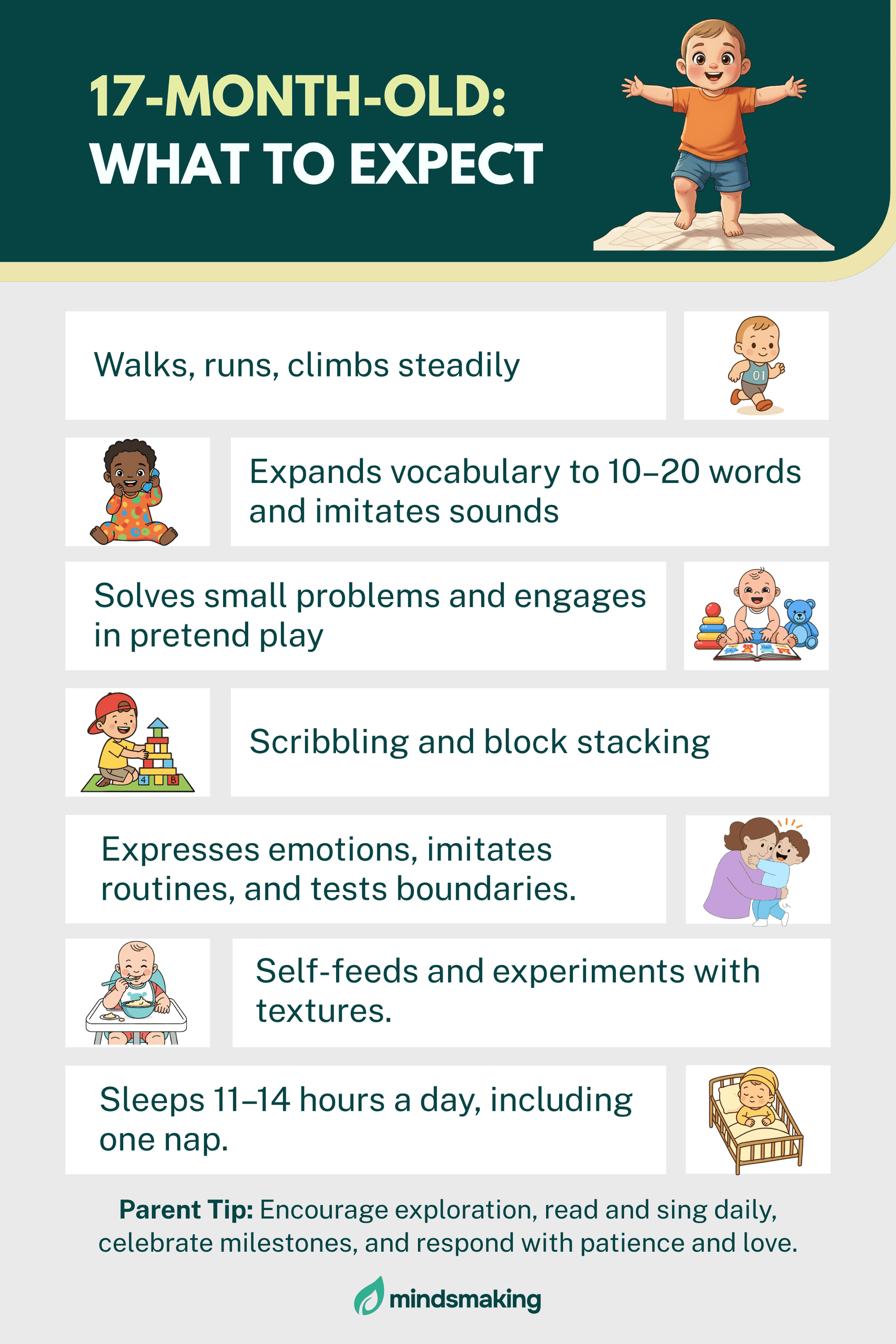
Your 17-month-old is likely walking with pride now, sometimes even with that confident little swagger that says, “Look what I can do!” They may begin to run or climb more skillfully, turning every corner of your home into an obstacle course. Though you might find yourself saying “slow down!” often, these are wonderful signs of steady progress in their development milestones.

Attempting to kick or throw a ball
It may not look like a perfect kick, but your toddler’s attempts are big wins. They will kick, throw a ball, or even miss completely, but each try improves coordination, balance, and leg control. It is clumsy, cute, and full of effort.

Enjoying push and pull toys and dancing to music
Push and pull toys are now among their favorites. Whether dragging a toy truck or pushing a tiny stroller, your little one is practicing coordination in disguise. Add a tune, and you will see some unforgettable dance moves like bouncing, twirling, and shaking. These are all signs of a happy, active child developing rhythm and balance.

Trying to navigate uneven surfaces like grass or steps
Your toddler is ready to walk on uneven ground like grass, carpet, or steps with determination and focus. Those moments when they stumble, giggle, and try again are also important. That is exactly how they master movement and body control.

Using spoons and cups with better coordination
Mealtime is slowly transforming from a mess-fest into a mini showcase of independence. Your toddler can now use a spoon or drink from a cup with better control. Spills can still happen, but every attempt is a step towards development.

Stacking blocks, turning knobs, or opening simple containers
Tiny hands are becoming more capable each day. You will see your child stacking a few blocks, turning knobs, or opening small containers, even the ones you did not plan for. These activities build hand strength, problem-solving, and growing cognitive skills.

Starting to draw lines or dots with crayons
Give your little artist a crayon, and prepare to admire their colorful “masterpieces.” Scribbles, lines, and dots may not make sense to you, but to your toddler, they are early lessons in grip control and creativity. This is an exciting development milestone toward writing.

Using fingers precisely
Finger control is reaching a whole new level. Your toddler now loves pressing buttons, pointing at everything, and turning book pages. These small yet important movements show how much their coordination and curiosity have improved.
Language Development
By now, your 17-month-old is finding their voice, and they are loving every sound of it. Words, babbles, and giggles are now part of your daily soundtrack. This stage of speech development is where communication starts to feel real. They are not just making noise; they are trying to connect, tell stories, and get your attention in the most adorable ways. Here is what to expect as their language milestones continue to bloom.
Vocabulary expanding to 10–20 words: Your little one’s word list is growing fast. Around this age, most toddlers can say about 10 to 20 words including names, favorite toys, or simple actions like “go” and “eat.” They may not pronounce everything clearly, but every attempt is a proud step in their cognitive skills and communication growth.
Understanding short phrases and two-part instructions: Your toddler now understands more than they can say. Simple directions like “get the ball and give it to me” make perfect sense, though they might hand you the shoe instead. It is all part of the learning process and a key development milestone in brain development and comprehension.
Imitating sounds and copying tone or rhythm of speech: Toddlers at this stage are natural mimics. They copy sounds, tone, and even your expressions. Every “oh no!” or giggle they repeat helps fine-tune their pronunciation and rhythm, which strengthens their growing language skills.
Using gestures, words, and eye contact to communicate meaning: Talking is not just about words for your toddler. They point, wave, and lock eyes to get their message across. These little cues show how their communication skills and understanding of emotions are coming together beautifully.
Starting to name familiar people, pets, or body parts: Naming things is your baby's favorite new game. You will hear sweet attempts like “mama,” “dog,” or “nose,” each said with pride. These first labels are signs of growing memory, curiosity, and speech development.
Cognitive Development
Your 17-month-old’s brain is full of curiosity. Every sound, object, and reaction fascinates them and it is like they are running little science experiments all day. This stage of 17-month-old toddler development comes with discoveries that reveal just how quickly their cognitive skills are growing. They are learning how things work, remembering patterns, and even pretending their teddy can talk back. Here is what is going on inside that busy little brain:
Understanding cause and effect: Your toddler has become a tiny researcher, testing what happens when they drop, throw, or splash something. This is because watching your reaction is half the fun. This growing curiosity about how actions lead to results is an exciting development milestone and their way of learning how the world works.
Showing early problem-solving: From opening boxes to stacking toys for that “out-of-reach” item, your toddler is now thinking ahead. They are learning that solving a problem takes more than luck, it takes persistence, and maybe a little bit of climbing.
Displaying memory and anticipation: At 17 months, your baby is beginning to show signs of memory and also anticipate events. They may start clapping before you play their favorite song. They are also beginning to predict what comes next, whether it is snack time after play or a bedtime story after bath. This sense of routine gives them comfort and shows their growing cognitive skills.
Engaging in pretend play: Pretend play is now in full bloom. You might catch them talking on a toy phone or feeding their doll with great seriousness. It is not just cute, it is their imagination taking off. This early creativity lays the foundation for stronger communication and language milestones later on.
Demonstrating attention span improvement: Of course, your little one still gets distracted by the odd shiny thing, but their focus is improving. They can now listen to a short story or complete a small task before moving on. Every moment of concentration, however brief, strengthens their learning activities and sets the stage for more structured play ahead.
Read This Next
No posts available
Social and Emotional Development
At 17 months, your toddler’s emotions are louder, bigger, and more expressive than ever. They show joy, frustration, shyness, and even defiance. These emotional ups and downs are part of normal 17 month-old toddler development and what to expect. Your little one is learning how to express their feelings and test limits, often by saying “no” just to see how you will respond. It is not rebellion, it is how they show independence. This also shows that your toddler is beginning to understand their own emotions and behavior.
This stage also brings a burst of affection that melts every parent’s heart. Your toddler might give you spontaneous hugs, kisses, or cuddles to show their growing emotional connection. You will also notice them imitating daily routines like wiping the table, talking, or feeding their dolls. This is their way of copying your actions with pride. These imitations are signs of healthy brain development as your toddler learns how relationships and routines work through observation and play.
Empathy and attachment are also getting stronger at 17 months. Your child may comfort someone who is sad, pat your back when you look tired, or bring you a toy to make you smile. At the same time, they may become more attached to caregivers and test boundaries like refusing to share a toy or insisting on doing things alone. You might see some separation anxiety when you step away, but that clinginess is a sign of deep trust. Every giggle, cuddle, and even meltdown reflects how your little one is learning to feel, connect, and love.
Sleep and Feeding Patterns
Around 17 months, your toddler is finding their sleep rhythm. Most babies need about 11 to 14 hours of sleep in a day at this stage, usually with one afternoon nap. Do not be surprised if sleep gets a little bumpy. Teething, growth spurts, or even their new sense of independence can make bedtime feel like a mini adventure. They will drift off easily some nights, other nights, they will protest with all the energy of a tiny night owl. Stay calm, these sleep disruptions are temporary and part of normal 17 month-old toddler development.
When it comes to food, your toddler is ready for three meals and two snacks a day. They are mastering the art of self-feeding. You can tell by how they are proudly wielding a spoon, dropping food, and drinking from a cup with growing confidence. This stage is less about perfect table manners and more about building fine motor skills and independence. Encourage them to explore textures, colors, and tastes. Every messy bite is a mini lesson in food coordination.
Appetite can vary wildly from day to day at this stage. One moment, they are eating like they have discovered food for the first time; the next, they are pushing the plate away after two bites. Do not worry, this pickiness is a normal part of toddler behavior. Their growth rate is slowing a bit, and their appetite follows suit. Offer healthy food options, keep mealtime relaxed, and trust that your little one knows when they’re full. Soon enough, those small bites will add up to big growth
Activities to Support Development
Your toddler is in a phase where learning happens through play, exploration, and imitation. Every new action molds their growing mind and body. Engaging in the right activities not only supports their 17 month-old toddler development but also builds confidence, creativity, and emotional awareness in fun, natural ways.
- Encourage outdoor play such as walking, climbing, and dancing, as it helps your toddler strengthen muscles, balance, and coordination while exploring their surroundings.
- Build fine motor control through stacking blocks, scribbling with crayons, or sorting shapes and boosts confidence in self-feeding and play.
- Support language development by naming objects, singing songs, and reading together to expand your child’s vocabulary and understanding of the world.
- Foster imaginative play using toy kitchens, dolls, or pretend phone calls to inspire creativity and help your toddler express thoughts and emotions.
- Teach social skills through simple sharing or turn-taking games; it encourages patience and empathy during playtime with others.
- Model emotional regulation by naming and validating emotions calmly, this helps your little one understand feelings and learn how to express them safely.
When to Talk to a Pediatrician
When you keep an eye on your toddler’s development, it helps ensure they are hitting important milestones and getting the support they need to thrive on time. Every child grows at their own pace, but sometimes, delays or unusual behaviors can signal that a little extra help is needed. Reaching out to a pediatrician early can make a big difference in identifying and addressing any concerns.
- Not walking independently or avoiding physical activity may suggest a delay in gross motor skills, and it is worth discussing with your pediatrician for further evaluation.
- No spoken words or limited understanding of simple phrases could indicate a delay in speech or language development and should be checked to ensure healthy communication progress.
- Lack of interest in people, toys, or surroundings may point to social or cognitive challenges that need early attention to support engagement and curiosity.
- Persistent difficulty in sleeping or eating might signal underlying discomfort, developmental issues, or emotional stress that a pediatrician can help assess.
- Rarely expressing emotion or not imitating behaviors can be an early sign of developmental or social delays, and bringing it up during a checkup can help guide early intervention and support.
A Word from Mindsmaking
Finally, it is time to celebrate how far your baby has come. Your 17-month-old is now an adventurous explorer, full of chatter and affection. Every step, word, and giggle is a reason to cheer.
As your toddler grows and begins to show independence, it is important to balance freedom with gentle limits for their safety. Remember, every toddler develops at their own pace. Some may talk sooner, others may climb a little slower, and that is perfectly normal. What matters most at this stage is love, laughter, and patience.
Was this article helpful?
How many stars are you giving this article?
Leave a comment
Your email address will not be published.