13-Month-Old Toddler Development and What to Expect

Written by Mindsmaking Medical Writer

Fact Checked by Mindsmaking Professionals
1st, December, 2025
The 13-month-old stage is when your toddler begins to explore independence like a boss. They want to try new things, yet they still have separation anxiety.
At 13 months, your baby has moved from being that little infant to the early toddler stage. So much mouth-opening growth has happened already, and more is still on the way. This is when your baby’s communication skills begin to shine through simple words, funny sounds, and adorable gestures.
Of course, your baby’s development is not just about early speech. Your toddler is now more active, curious, and eager to explore their independence. So, that short-lived nap at noon is simply a normal part of your 13-month-old baby’s development.
Your 13-month-old baby’s development is filled with connection, expression, and learning through imitation. While your little one is transitioning, you will also learn how to make this phase fun, enjoyable, and memorable for both of you.
Key Takeaways
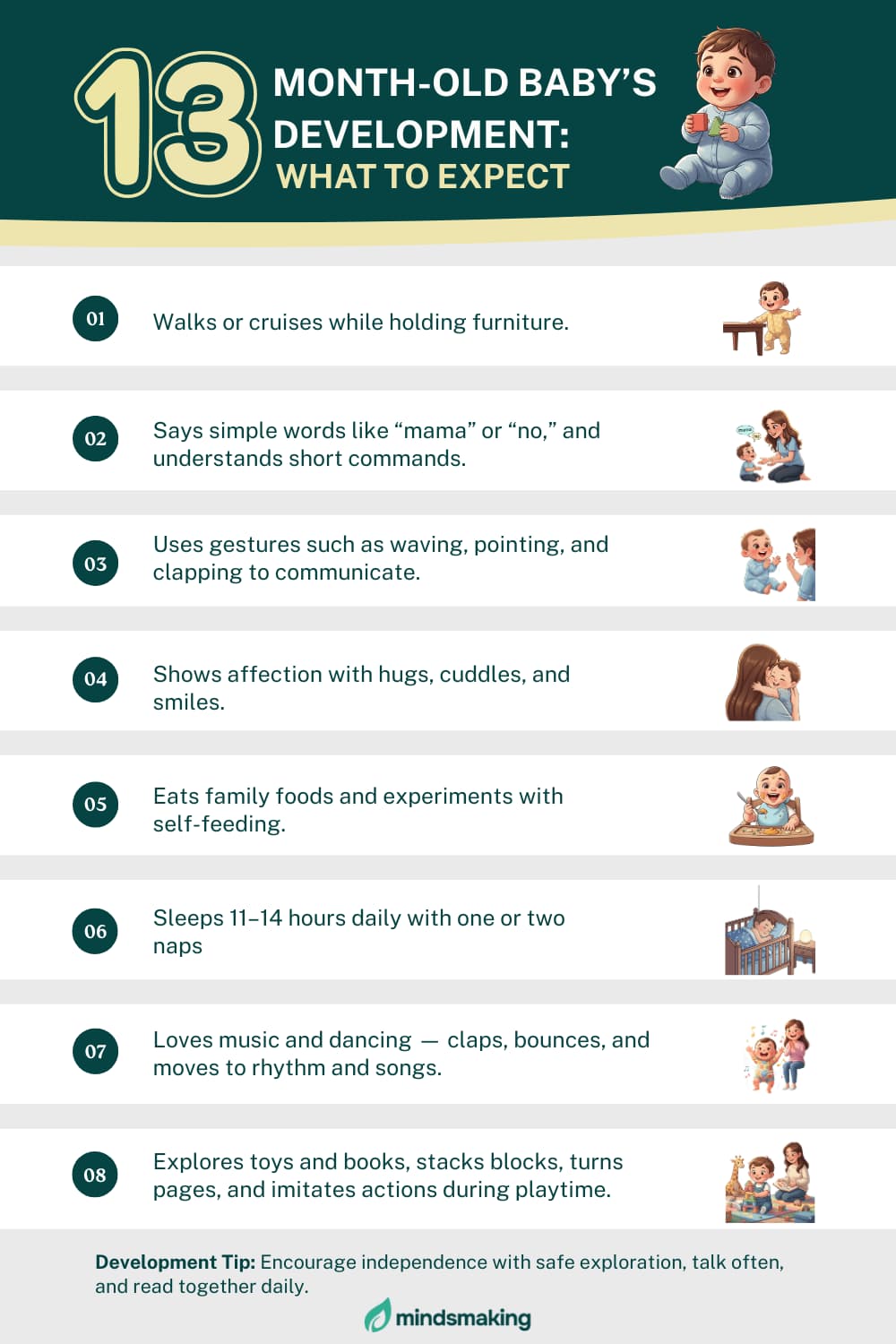
At 13 months, your baby’s world is in motion; walking, climbing, balancing, and exploring take center stage as fine motor skills sharpen and curiosity fuels every adorable wobble forward.
Your 13-month-old’s brain is buzzing with curiosity, linking actions to meaning, solving tiny problems, and copying your every move as play becomes their most powerful learning tool.
Your 13-month-old is turning babbles into real words, gestures, and sounds, showing growing communication skills through talking, listening, and the cutest early attempts at real conversation.
At 13 months, your baby’s emotions are blooming, showing affection, empathy, and a growing desire for independence, even as they cling a little tighter during moments of separation.
At 13 months, mealtimes are messy but meaningful; your toddler is learning independence through self-feeding, exploring new textures, and building healthy eating habits one bite at a time.
At 13 months, your baby needs about 11–14 hours of sleep daily. A consistent bedtime routine helps them settle easily, even through teething or milestone-related sleep disruptions.
Play is how your 13-month-old learns best. Simple activities like stacking, dancing, reading, and pretend play build coordination, creativity, language, and confidence every day.
Trust your instincts; if your 13-month-old isn’t showing key signs like standing, responding, or using gestures, it’s wise to check in with your pediatrician for reassurance and guidance.
Physical and Motor Development
Your baby is now more mobile than ever, and you cannot even compare this stage to the 12-month-old baby's development. The curiosity that once kept them staring at colorful toys is now giving their little legs energy to move, climb, and reach for anything that looks remotely interesting. This stage of your 13-month-old baby’s development is full of excitement, new milestones, and a few near tumbles that will keep you on your toes. Here is what you should expect:
Physical and Motor Development

Walking and Wobbling
Those first steps may look unsteady, but they are a big part of your baby’s physical development. Whether your little one is still holding onto furniture or proudly walking across the room, it is all progress. Some babies prefer crawling because it is faster, but that determined look before every step says it all.

Climbing and Squatting
Everything suddenly becomes a problem to solve, be it sofas, stools, or even your legs. Your baby might squat to pick up a toy and then try standing without holding onto anything. It is both funny and impressive, even if you are silently praying that they will not try to spoil the TV remote someday.

Improved Balance and Standing
You will notice fewer dramatic falls and more confident movements. Their balance is improving every day, and though they may still wobble like a tiny penguin, those wobbles are signs of strong coordination in progress. Keep cheering them on, they are learning fast and mastering new baby activities.

Turning Pages and Pointing
Your baby's tiny fingers are getting smarter. They may start turning pages of a picture book, pointing to objects they find interesting, or showing you exactly what they want. Sometimes, that pointing comes with an impatient sound that clearly means, “Hurry up, Mom.” These small demonstrations show that their fine motor skills are also developing.

Stacking and Self-Feeding
Stacking blocks, dropping them, and rebuilding are all serious business for your baby. Self-feeding also gets better around this time, though you might find more food on the floor than in their mouth. Do not worry, it is all part of learning.

Slower Growth, More Movement
You might notice your baby is not gaining weight as quickly anymore, and that is perfectly normal. With all these movements, most of their energy now goes into action rather than size. They are literally growing through motion. Their routine now revolves around exploring, moving, and mastering balance, not just eating and sleeping.
Encouraging Safe Exploration
Create a safe space where your little one can move freely without too many “no’s.” Encourage crawling, climbing, and walking in open areas, and let them explore under your watchful eyes.
Cognitive Development
Your 13-month-old baby’s development is not limited to just movements, their mind is also growing at full speed. Every day, you will see new baby milestones that show how much they understand, remember, and copy from the world around them. It is a stage filled with curiosity, learning activities, and moments that will make you laugh out loud. The following are signs that your baby's brain is developing:
Understanding of Object Use: Your baby now understands that objects have a purpose and is eager to prove it. They know the spoon is for feeding and the brush is for their hair. Obviously, your baby may also pick up your phone to have the most dramatic baby conversation ever. These little attempts are huge cognitive milestones showing that your child’s brain is connecting meaning with action.
Problem-Solving and Cause-and-Effect: If you have noticed your baby dropping toys just to watch them fall again, congratulations, you are raising a little scientist. Every action, from pressing buttons to opening drawers, is part of their problem-solving and cause-and-effect learning. They are discovering how the world works, and performing one experiment at a time. Sure, it can test your patience, but it is actually smart baby behavior.
Early Memory and Imitation of Adult Actions: This phase is when your baby’s memory starts to shine. They remember where their toys are, recognize familiar routines, and copy everything you do. From waving goodbye to pretending to make a phone call, imitation becomes their favorite baby activity. It is both heart-melting and slightly humbling when you see them mirror your every move.
Importance of Exploration and Responsive Play in Learning: Babies learn best when they are allowed to touch, move, and play freely. Responsive play, where you engage, laugh, and react to what they are doing, helps them understand emotions and cause-and-effect. These little moments of play are not just fun; they are powerful learning activities that mold your child’s behavior and understanding of the world.
Language and Communication
At 13 months, your baby’s communication skills are starting to show like never before. Those endless babbles are slowly turning into real words, gestures, and sounds that carry meaning. It is one of the sweetest parts of your 13-month-old baby’s development. Here is what you can expect:
Typical first words: Get ready for your heart to melt and your patience to be tested because “no” might soon become your baby’s favorite word. At this point, simple words like “mama,” “dada,” or “bye” start popping up more often. Each new word is one of those precious baby milestones that show how much your little one is learning from the world around them.
Comprehension of simple instructions: Do not underestimate your mini genius. Your baby now understands short, simple commands like “come here,” “sit down,” or “give me the ball.” Of course, following those commands is optional in their book, so do not let that bother you. This is a big step in cognitive and behavioral development, showing they are not just listening, but learning to respond to words.
Non-verbal communication: Before full sentences, your baby will display lots of gestures. Pointing at their cup, waving bye, or clapping after finishing a meal are all meaningful ways your baby “talks” without words. These cute signals are part of developing strong communication skills and emotional awareness.
Early speech imitation: Have you ever caught your little one babbling like they are giving a full-blown speech? That is an early imitation sign at work. They are copying your tone, rhythm, and even your dramatic pauses. This adorable habit lays the foundation for real conversations and is one of the most fun learning activities to watch unfold at 13 months.
Encourage reading, talking, and singing daily: You do not need to be a professional storyteller or singer, your voice is already your baby’s favorite. Reading, singing lullabies, or narrating your daily baby routine helps improve their language foundation.
Read This Next
No posts available
Social and Emotional Development
Your 13-month-old’s world is now filled with emotions, affection, and little tests of independence. This stage of your baby’s development shows you just how quickly they are learning to connect, express, and sometimes, protest. Here is what is happening in their social and emotional world:
Attachment and Affection Toward Caregivers: Your baby’s love language right now is hugs, cuddles, and following you absolutely everywhere. You have officially become their favorite person or personal bodyguard. This strong attachment is healthy; it helps them feel safe enough to explore their environment, knowing you are always close by.
Early Empathy: Your little one might try to comfort you when they notice you look sad. They may also burst into giggles just because you laughed. They are learning emotional cues through imitation, and yes, your exaggerated happy faces are now part of their baby activities. These tiny gestures are early signs of empathy and your child’s way of saying, “I feel what you feel.”
Separation Anxiety and Clinginess Phase: If your baby suddenly acts like you are abandoning them every time you walk out of sight, do not panic. This clingy behavior is part of separation anxiety, and it is normal at this stage. It means your baby's understanding of presence and absence is growing. They are realizing you exist even when they cannot see you, and that discovery is both fascinating and terrifying to them. So, go ahead and sneak in those quick hugs before stepping out. It helps them feel reassured that you always come back.
Developing Independence and Frustration Tolerance: Between moments of clinginess, you will also see a bold sign of independence. Your baby might insist on holding the spoon, even if it means redecorating the floor with mashed potatoes. These tiny power struggles are part of emotional growth. They are learning to manage frustration and build persistence. Each “I can do it!” moment makes them better.
Feeding and Nutrition
Gone are the days when your little one relied solely on spoon-fed purees and mashed meals. Now, they are stepping into the exciting world of family solid foods with three meals and two snacks a day. You will notice that their curiosity extends to whatever is on your plate, and yes, they will want a taste of it too. This transition is more than just eating; it is a bold step toward independence. Expect a little dragging at mealtimes. You may even notice food on the table, floor, and possibly your hair, but it is all part of your baby’s growth.
For your toddler, the mealtime is another opportunity to display that they are now in control with self-feeding. Your toddler wants to grip that spoon, poke at everything, and sometimes feed you instead. While it might feel like a slow process, every spill and splatter builds coordination and confidence. Let them explore with their fingers, experiment with utensils, and enjoy the textures. The mess may be monumental, but so is the learning. Think of it as your baby’s version of “fine dining" but without the table manners.
When it comes to milk, your little one can now enjoy whole milk as part of their daily meals, or you can keep breastfeeding if that is what works best for you both. The goal is balance; serve colorful plates with fruits, veggies, grains, and proteins. Introduce new textures and flavors with a smile, even when they make funny faces or push the plate away like a picky eater. This stage is all about discovery, joy, and nourishment. Feel free to laugh through the mess because that may be your favorite stress relief.
Sleep Patterns
Your baby’s sleep schedule is starting to look a little more like a routine. At 13 months, your little dreamer needs around 11 to 14 hours of sleep in total, usually spread between nighttime rest and 1 to 2 naps during the day. You might notice a gradual shift toward one longer nap, and while that sounds like bliss, the transition can feel like a tiny tug-of-war between “I’m so sleepy” and “I refuse to miss out on fun.”
Consistency has to be your new best friend here. A predictable bedtime routine like a warm bath, a gentle lullaby, or a few pages from a bedtime story helps your baby know it is time to wind down. Babies thrive on familiar cues, and sticking to the same bedtime routine can help everyone fall asleep easily.
Of course, sleep disruptions are still part of the adventure. Teething pains or new milestones like standing or walking can make your baby’s brain too excited for bedtime. You might find them wide awake at midnight, proudly practicing their new trick in the crib. It is normal, and these phases pass.
Play and Learning Activities to Encourage Development
As your little one grows, play is not just fun; it is how their brain, muscles, and emotions stretch and connect. Your 13-month-old is learning, experimenting, and figuring out how the world works through every bounce, babble, and block tower. Below are types of play and simple learning activities that support development in multiple ways at this stage:
Push-Pull Toys, Stacking, Dancing, and Music Games: Your baby’s curiosity is now unstoppable. Push-and-pull toys help build balance and leg strength. Stacking cups or blocks also tests patience and hand control, which can improve their fine motor skills. When the music starts, let loose dancing, clapping, and shaking little instruments can improve your baby's rhythm, coordination, and joy.
Encouraging Movement and Coordination: Those tiny steps are turning into confident strides. Encourage crawling, climbing, and walking in safe spaces. It is how balance and strength grow. Try rolling a ball, playing gentle chase, or letting them push a toy cart around.
Reading as a Learning Tool: Books are an important asset for your toddler’s brain. Bright pictures and simple words keep them hooked, while repetition strengthens language and memory. If you have read the same story ten times, you are helping your baby learn. Make it interactive, point to pictures, name things, and use funny voices because the sillier you sound, the funnier and better for their development.
Simple Activities for Cognitive and Fine Motor Skills: Shape sorters, puzzles, and stacking rings help build your baby's problem-solving and coordination skills. Pretend play like feeding a doll or talking on a toy phone encourages creativity and emotional growth. Even daily routines can teach, let them scoop snacks, stir water, or drop toys into baskets. These simple tasks build independence and confidence. Always watch out for your baby during playtime.
When to Talk to a Doctor
It is completely normal to wonder if your baby’s development is on track, especially when you see other toddlers already running, waving, or chatting away. Every baby grows at their own pace, but sometimes, certain signs deserve a closer look. Knowing when to talk to a doctor doesn’t mean you’re overreacting; it means you’re paying attention, and that’s what good parenting is all about. Here is when it is best to reach out to your pediatrician:
- If your baby is not trying to pull up, stand with support, or bear weight on their legs, it is worth checking in.
- If your baby is not using gestures like waving, pointing, or reaching for things.
- If your baby does not respond to their name, familiar voices, or everyday sounds.
- If your baby has difficulty eating or swallowing, or seems unusually stiff or floppy.
Was this article helpful?
How many stars are you giving this article?
Leave a comment
Your email address will not be published.