4-Year-Old Development and What to Expect

Written by Mindsmaking Medical Writer

Fact Checked by Mindsmaking Professionals
2nd, February, 2026
Your 4-year-old is leaping into independence, speaking in detailed sentences, showing stronger emotions, building friendships and reaching new milestones in movement, creativity, and problem-solving. Here’s what to expect in this energetic preschool stage
Welcome to the vibrant world of age four, where your preschooler shows a little independence, a lot of strong opinions, and a fully blossoming personality. Their imagination soars, their emotions grow louder, and their “I can do it myself!” moments appear daily, bringing laughter, surprise, and the occasional deep sigh.
Four-year-olds often called the “fearless four" shine through bold curiosity, spirited debates, and tender bursts of empathy. It’s busy, unpredictable, and beautifully magical as they grow in communication, creativity, problem-solving, and physical skills. And remember, every child develops at their own pace, and a wide range of growth is perfectly normal at this age.
Key Takeaways
At age four, your child’s emotions are still big, fast, and full of surprises, but they’re starting to understand and express their feelings more clearly.
Tantrums aren’t gone yet, but they’re evolving. Now, they often involve negotiation and reasoning, such as arguments over bedtime, snack choices, or “just one more story.”
Language skills are growing quickly. Your child moves from simple sentences to storytelling, asking endless questions, and adorable mispronunciations.
Independence in almost everything. Whether it’s dressing themselves, using utensils, climbing playground equipment, or pouring a drink, their frequent “I can do it!” is a declaration of confidence and self-reliance.
New fears may suddenly arise from vivid imagination and a growing awareness of the world. Darkness, monsters, or being alone can be frightening.
By age four, your child is moving into cooperative play, actively working with peers, following simple rules, and negotiating roles in games.
At age four, your child is learning to understand rules but will naturally test limits to explore independence and make sense of the world.
By age four, children can solve simple puzzles, sort objects by color or shape, follow multi-step instructions, and begin to understand cause-and-effect, showing growing problem-solving and cognitive skills.
By age four, children can typically draw recognizable shapes and figures, run, jump, and climb with improved coordination, and perform daily self-care tasks like dressing and using utensils with increasing independence.
Eating habits can feel like a moving target. Your four-year-old may go through picky phases, sudden favorites, or complete rejections of foods they loved yesterday.
Around four years old, your child may drop daytime naps and suddenly have boundless energy at bedtime, turning evenings into a playful test of patience.
By age four, your child is often confident with daytime potty control, though staying dry at night may still take time.
By age four, your child’s imagination can make shadows or everyday situations seem scary, and reassurance is still needed.
Watch for a few gentle red flags: very limited language, difficulty engaging with peers, extreme distress over changes, persistent sensory overwhelm, or a lack of imaginative play.
Emotions Continue to Evolve
Welcome to the emotional landscape of age four, a place where feelings are still big, still fast, but now just a bit more understandable. Four-year-olds are beginning to recognise their emotions and communicate them with growing confidence. One minute they’re proudly showing off their drawing, the next they’re frustrated because their tower fell, and moments later they’re checking on a friend with a gentle, “Are you okay?”
You’ll start to hear clearer emotional expressions like “I’m upset,” “I don’t want that,” or “I feel happy,” but these are still early steps in navigating complex feelings. Sensitivity remains high, and mood swings can still appear without warning. A small disappointment can trigger tears, while a tiny victory can spark a loud celebration, all perfectly normal at this stage.
These emotional ups and downs aren’t misbehavior; they’re signs of a child learning to name, understand, and manage their inner world. Your calm presence, reassuring words, and consistent comfort help them build the foundations of empathy, self-awareness, and emotional regulation that will continue to grow throughout childhood.
Tantrums Become Less Frequent but More Strategic
By age four, tantrums usually happen less often, but the ones that do appear feel different from toddler tantrums. Instead of crying or flopping to the floor, your child now uses words, explanations, and even negotiation to push for what they want. You might hear confident statements such as “I’m not tired yet,” “Just one more minute,” or “But I didn’t finish my game,” which indicate a growing understanding of how conversations can shape outcomes.
These moments often pop up around transitions and limits. Leaving the playground, turning off the TV, stopping a fun activity, or shifting to routines such as bedtime or mealtime can trigger frustration or resistance. The reaction may not be loud or dramatic, but it’s more intentional. Your child is testing boundaries, trying to influence decisions, and seeing how far their reasoning can go.
Even though these tantrums can feel challenging, they’re actually a sign of healthy emotional and cognitive growth. Your child is learning to express their needs with words rather than just emotion, and they’re beginning to understand cause and effect. If I explain it this way, maybe I’ll get a different answer. This is early problem-solving, early self-advocacy, and early emotional awareness, all unfolding simultaneously.
With calm guidance, consistent boundaries, and empathy, you can help your child navigate this stage more smoothly. Every strategic tantrum is an opportunity to teach patience, flexibility, and communication. And while the debates might sometimes feel endless, they are laying the foundation for stronger self-control and better emotional regulation in the years ahead.
Conversations Get More Complex
By age four, your preschooler's language skills are taking off, turning everyday chats into full-on conversations. You’ll notice them speaking in complete sentences, telling you exactly what happened at preschool, or asking endless “how” and “why” questions to figure out the world. They can follow multi-step directions such as “Pick up your toys, put the books on the shelf, and then wash your hands,” which demonstrates their growing focus and understanding.
Storytelling becomes their favorite way to share adventures or exaggerate them for dramatic effect! You might hear tales of heroic dinosaurs or epic playground battles. Early humor also begins to emerge, with little jokes, funny faces, or silly observations that leave you laughing together. These moments reflect their cognitive development and the joy of using speech and language skills to express themselves.
You’ll also notice problem-solving popping up in daily life. They might explain why their block tower tumbled, suggest a way to fix a puzzle, or brainstorm strategies for sharing toys with friends. Watching them reason through these situations is a window into their thought processes and creativity and a reminder of just how much they’re learning and growing every single day.
Independence Is in Full Swing
At age four, your preschooler is eager to take charge of daily routines, from dressing themselves and brushing teeth to feeding and tidying up their toys. You’ll notice them insisting on doing tasks on their own, even when it takes longer or gets messy, because this independence is a major source of pride. They may become frustrated if you intervene too soon or upset if support isn’t offered, indicating how much they value control over their own choices.
This desire for independence is an important part of 4-year-old development and what to expect. Every successful attempt, whether buttoning a shirt, pouring cereal, or putting away toys, boosts confidence and teaches problem-solving skills. It also shows that they are developing fine and gross motor skills while learning to navigate everyday challenges.
At the same time, independence can give rise to power struggles. You may find yourself negotiating over bedtime routines, snack choices, or who gets to pick the activity. These moments are normal and actually beneficial; they help your child learn to handle frustration, practice patience, and build resilience. By encouraging effort, offering gentle guidance, and celebrating small successes, you help your child grow into a confident, capable, and self-reliant individual.
Read This Next
No posts available
Imagination Flourishes
At age four, your preschooler’s imagination really takes off, turning everyday moments into elaborate adventures. Pretend play becomes more sophisticated, with role-playing, storylines, and entire imaginary worlds. You might find them running a “store,” reenacting family routines, or zooming around as superheroes saving the day, all with impressive creativity and attention to detail.
It’s also common for them to mix reality and fantasy, blurring the lines in ways that can surprise or amuse you. They may talk to invisible friends, explain why their stuffed animals need dinner, or weave fantastical elements into real-life situations. This playful blending of real and imagined scenarios shows their growing cognitive development and problem-solving abilities.
Imaginative play isn’t just fun, it’s a critical tool for growth. Through these creative stories and role-plays, your child practices emotional processing, learns to understand different perspectives, and experiments with problem-solving in safe, playful ways. Sit with them during play, mirror one of their characters, or ask, “What happens next?” These small prompts guide their imagination, build emotional skills, and turn playtime into real learning.
Friendships and Social Skills Expand
Your 4-year-old is moving beyond parallel play, in which they play alongside other children, and associative play, in which they share materials with little collaboration. Now, cooperative play is becoming more common, with your child actively working with peers, following simple rules, and negotiating roles in games. They begin forming genuine friendships and demonstrating loyalty, often saying, “I want to play with Sam,” or insisting on including certain friends in their activities.
Conflicts are a natural part of this stage. Your child may argue over sharing toys, disagree on game rules, or feel frustrated when peers don’t cooperate. These moments are challenging, but they’re also powerful opportunities for social and emotional growth. They help your child understand fairness, consider other people’s feelings, and practice patience in real situations.
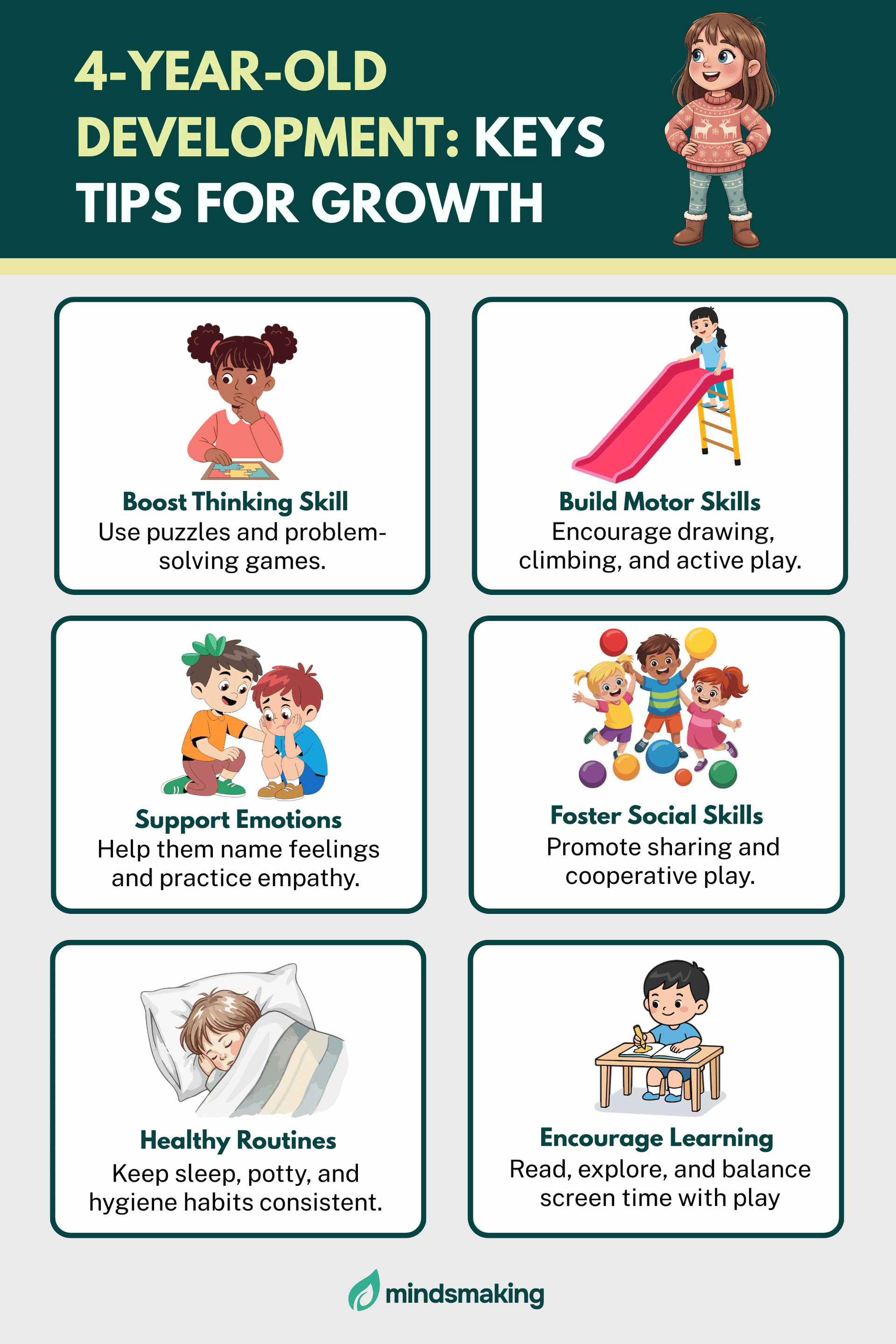
Through play, your child learns key social skills like empathy, turn-taking, and resolving disputes. Every compromise, apology, or negotiation strengthens their ability to build lasting friendships, communicate effectively, and navigate social situations with confidence. Observe their play, name what you see, and offer quick guidance when needed (“Let’s try that again,” “Maybe you can ask nicely”). These small interventions teach them how to navigate relationships confidently.
Testing Boundaries and Rules
By age four, preschoolers begin to understand rules more clearly, but that doesn’t stop them from testing limits; it’s their way of exploring independence and learning how the world works. You may notice them saying “No” multiple times when asked to follow a routine, negotiating for extra screen time, or finding creative ways to bend rules, like trying to sneak an extra cookie after snack. These moments can feel exasperating, but they are also important opportunities for your child to practice reasoning and self-expression.
Testing boundaries is a natural part of 4-year-old development and what is expected, as your child experiments with decision-making, problem-solving, and understanding consequences. Each act of resistance or negotiation is a sign that they are learning to assert themselves, think critically, and explore their growing autonomy.
As a parent, you can make boundaries and routines feel predictable by doing simple things like keeping meal and bedtime schedules steady, repeating the same steps during transitions, and following through on rules you’ve already set. When you calmly restate expectations and guide them through choices, you give them the safety to explore while learning independence. These small, consistent actions help them build self-control, confidence, and the social-emotional skills they’ll rely on as they grow.
Problem-Solving and Cognitive Skills Grow
At age four, your child’s mind is bursting with curiosity and a desire to figure things out. They’re starting to approach challenges in ways that might surprise and sometimes amaze you. Simple puzzles, sorting toys by color or shape, or stacking blocks without them toppling are not just play, they’re exercises in reasoning, planning, and experimentation. You’ll notice them pausing thoughtfully before making a choice, testing different strategies, or proudly saying, “I did it myself!” when they succeed.
Every day moments become little lessons in logic and creativity. When your child asks “why” a ball rolls or “how” a toy works, they’re learning to connect cause and effect. They might invent their own games, adapt rules, or find clever ways to accomplish a task, such as reaching a high shelf with a step stool or finding a shortcut to complete a puzzle. These small victories are signs of a mind learning to think critically and anticipate outcomes.
Problem-solving skills also appear in social situations. Sharing, negotiating, and resolving minor disagreements with friends or siblings requires reasoning and empathy. Your child begins to understand that actions have consequences, both for themselves and others, and they’re learning how to plan, compromise, and make decisions independently.
You can nurture this growth by providing hands-on activities, asking open-ended questions, and offering challenges that match their interests; activities such as building, sorting, or imaginative play are effective. Celebrate their attempts, not just their successes, to encourage confidence, curiosity, and a lifelong love of learning. Every small challenge they tackle is a step toward becoming a confident, thoughtful problem-solver.
Fine and Gross Motor Skills Advance
At age four, little minds are buzzing with curiosity, creativity, and a growing ability to figure things out. Their tiny hands can now draw shapes, letters, or even simple stick figures that sometimes surprisingly resemble people, and other times are hilariously abstract. Cutting with scissors becomes a thrilling challenge, and threading beads is no longer a magical mystery; it’s a patient, focused activity that builds hand-eye coordination while testing your nerves. These small achievements make them beam with pride and leave you equally amazed.
Gross motor skills are taking off like a rocket. Running, jumping, climbing, and hopping are no longer just possible; they’re perfected with dramatic flair. Four-year-olds navigate playgrounds like tiny explorers, balance on beams like future gymnasts, and attempt early sports skills with boundless enthusiasm. Watching them kick a ball with more control than last week or hop on one foot while insisting, “I’m flying, Mommy!” can be equal parts heart-melting and exhausting. Their bodies are learning to do amazing things, and their energy seems endless.
Independence also stretches into everyday tasks, and it’s a mix of adorable and exasperating. Many four-year-olds insist on dressing themselves, sometimes mismatching shoes or wearing pajamas over day clothes, yet they beam with accomplishment. Using utensils at mealtime becomes less messy, and personal care, such as washing hands or brushing teeth, begins with minimal reminders. These milestones are not just practical; they’re confidence boosters, tiny rebellions, and a window into the little person your child is becoming.
Eating Habits and Independence
At age four, your preschooler’s appetite can be as unpredictable as their moods. One day they’re happily crunching peas, and the next day those same peas are suddenly “lava.” This pickiness is normal; it’s their way of asserting independence and shaping their growing personality. Whether they want carrots arranged “just right” or insist on the perfect order of bites, it’s equal parts amusing and a glimpse of their developing self-expression.
During meals, your child begins to assume a small chef-and-server role. They want to pour their own milk, choose among snacks, and help themselves, even if it leads to occasional spills. These cute but messy moments are more than play; they are opportunities to practice coordination, decision-making, and logical thinking as you cheer them on.
Your four-year-old is also taking real pride in handling parts of their meals independently. From cutting soft foods with supervision to arranging their plate in their own creative way, each small task boosts confidence. Even when things tip over or crumbs scatter everywhere, they’re learning resilience, responsibility, and self-reliance.
Mealtimes become beautiful opportunities for connection and growth. Sitting together, offering choices, and celebrating small victories help your child build emotional, social, and practical skills. Every poured drink, self-served snack, and carefully chosen bite becomes a tiny triumph, reminding you just how capable and independent your four-year-old is becoming.
Sleep Patterns and Routines Change
By age four, your baby's sleep can feel like a wild adventure with unexpected plot twists. Many children begin to drop daytime naps entirely, which may seem convenient until bedtime arrives and they suddenly have enough energy to power a small rocket. That yawning, rubbing-eyes child you saw after lunch may now be zooming through the living room at 7:30 p.m., insisting, “I’m not tired yet!” It’s a normal part of their growth as their bodies need less daytime sleep, but it can make evenings feel like a battle of wills.
Bedtime battles can resurface, often fueled by imagination, curiosity, or tiny fears. Your child may suddenly remember every toy, shadow, or story character in existence, and use them as reasons to delay sleep. “One more story!” or “I’m scared of the monster!” may sound familiar. These moments, though exhausting, are part of their learning to distinguish reality from imagination and to test their independence in a safe environment. Yes, sometimes your patience will need superhero-level stamina.
Nighttime fears are a hallmark of this age. Darkness, strange sounds, or being apart from you can trigger worries about monsters or the unknown. Offer comfort by turning on a nightlight, placing a favorite stuffed animal nearby, or holding their hand for a few moments to reassure them that they are safe. Even the tiniest routines, like a consistent bedtime song or story, create a sense of security and help them feel in control of bedtime, turning anxiety into calm confidence.
Sleep quality directly impacts mood, behavior, and energy levels. A well-rested four-year-old wakes up bright-eyed, cooperative, and ready to explore the world, while poor sleep can lead to tantrums, irritability, or endless whining about every minor inconvenience.
Getting the Hang of Going Potty
By age four, your preschooler is often confidently managing daytime potty needs, which is a huge milestone for both of you. You might catch them proudly running to the bathroom on their own, announcing, “I don’t need help, Mommy!” These moments bring pride both ways: your child’s for doing it independently, and yours for seeing just how much they’re growing. Nighttime control, however, can still take time. Bedwetting or occasional accidents are normal as their bodies learn to manage bladder signals during sleep, so there’s no need to stress; it’s just another part of their development journey.
Sometimes, even after mastering daytime control, your child may temporarily regress, especially during stressful events or major life changes. Moving homes, starting preschool, or welcoming a new sibling can trigger minor setbacks, such as refusing to use the potty or having unexpected accidents. These moments can feel frustrating, but they’re not a sign of failure. Your reassurance, patience, and gentle encouragement help your child feel secure while they regain confidence and return to their usual routine.
Developing Awareness of Fears and Safety
By age four, your child’s imagination is running wild, which can turn ordinary shadows into monsters and quiet corners into mysterious caves. Suddenly, even familiar spaces or harmless animals can feel scary. You may hear dramatic declarations like, “The dark is scary!” or “That dog is going to get me!” It can be exhausting, a little amusing, and utterly heart-melting all at once. These fears are perfectly normal and show that your child is learning to make sense of the world while testing their boundaries.
At this stage, children are also beginning to distinguish between real danger and fantasy, though it doesn’t always stop the shivers or the repeated “Are you sure it’s safe?” questions. They may recognize that monsters aren’t real, but they still want reassurance, and who can blame them when their imagination is working overtime? They’re also learning basic safety rules, such as not touching hot surfaces, staying close in public, and asking for help when unsure. Their reasoning skills are growing, but fears can still feel very intense, making gentle guidance, patience, and humor essential in helping them navigate these emotions.
It’s important to know that these fears are developmentally normal. Experiencing fear is part of emotional growth, helping children practice self-regulation, develop caution, and build confidence as they learn how to handle challenges. Respond by acknowledging their feelings, giving calm explanations, and using playful humor, like joking that “the monster only eats broccoli”, to help them feel safe and supported. These small, consistent actions not only provide comfort but also teach your child resilience, courage, and independence.
Signs to Watch For
As your four-year-old grows, some tasks will feel easy while others may be more challenging, and that’s perfectly normal. Certain signs, however, can indicate areas where extra support or guidance might be helpful. Think of these as gentle guideposts rather than warnings.
- When a child consistently withdraws from other kids, avoids joining group play, or seems anxious around peers, social situations may feel overwhelming for them.
- If they struggle to form simple sentences, use only a few words, or are difficult to understand, their communication skills may need additional support.
- Strong emotional reactions to small changes, like a different cup, a new routine, or switching activities, can show that transitions are particularly challenging.
- Frequent discomfort with sounds, lights, textures, or clothing may suggest that everyday sensory experiences feel too intense.
- Very limited pretend play, such as avoiding make-believe stories or imaginative roles, can indicate that creative and flexible thinking needs more nurturing.
- Difficulty staying focused on age-appropriate tasks or becoming easily frustrated may point to challenges with attention or self-regulation.
Frequently Asked Questions
What should I expect from my 4-year-old’s development?
Age four is full of curiosity, big feelings, and endless questions. Your child is learning to express emotions, solve problems, play with friends, and tackle small challenges, all while showing more independence and personality than ever before.
Is it normal for my 4-year-old to still have tantrums?
Tantrums at this age are often more strategic. Your child might argue, negotiate, or test limits rather than just cry. It’s not misbehavior; it’s their way of practicing independence, reasoning, and self-expression.
How do 4-year-olds handle emotions?
Four-year-olds experience strong emotions, from pride to frustration, and are learning to identify and discuss them. Mood swings are normal, and your calm reassurance, patience, and understanding help them develop empathy and emotional regulation.
How can I support my 4-year-old’s social development?
Encourage cooperative play, sharing, and turn-taking, and guide conflicts gently. Praise empathy, provide group activities, and model positive interactions. Every compromise or apology strengthens their social skills and confidence.
How can I support my 4-year-old’s learning at home?
Play games, do puzzles, read stories, and explore creative projects together. Ask questions, encourage problem-solving, and let your child experiment. Every playful activity is an opportunity to develop critical thinking, creativity, and independence.
Is it normal for 4-year-olds to test limits?
Testing boundaries is their way of exploring autonomy, understanding consequences, and asserting themselves. Establish clear, consistent rules while allowing them to practice independence safely.
How can I support my 4-year-old’s language and cognitive growth?
Talk, read, and tell stories together. Encourage counting, sequencing, problem-solving, and imaginative play. Celebrate funny mispronunciations, clever ideas, and “aha!” moments; these show your child’s mind is growing fast.
How can I balance screen time and play for my 4-year-old?
Set clear limits on screen time and prioritize active, hands-on, imaginative play. Join in when possible and use screens as tools, not replacements for interaction, exploration, or movement.
Was this article helpful?
How many stars are you giving this article?
Leave a comment
Your email address will not be published.