15-Month-Old Toddler Development and What to Expect

Written by Mindsmaking Medical Writer

Fact Checked by Mindsmaking Professionals
15th, December, 2025
Your 15-month-old toddler is perfecting their steps every day, standing, walking, and pulling up. You may even catch them running or making an attempt. Definitely, growth is all around for you to see.
After several weeks and months of steady growth, your baby has reached the exciting 15-month mark. Their curiosity is still unstoppable, and you can tell by the way they explore every corner, open drawers they ought not to, and show independence in the most adorable ways.
At this stage of your baby’s development, you can expect more walking, better balance, and bolder steps than before, particularly in the 14-month-old baby’s development. Now, your toddler is in full motion with energy levels that might just outmatch yours.
Your baby continues to grow in every possible way, and this shows in how they act, play, move, learn, and even talk. To better support your growing baby, it is important to understand what this month’s milestones bring and when to simply seek medical support.
Key Takeaways
At 15 months, your toddler is moving with confidence, walking, climbing, and feeding themselves. Every stumble, scoop, and stack shows growing strength, balance, and independence.
Your 15-month-old is thinking, exploring, and figuring things out like never before. Every game, every stack of blocks, and every little “try again” moment shows their growing understanding and memory.
At 15 months old, your baby is starting to communicate with words, gestures, and pointing. Every “mama,” nod, and tiny instruction followed shows growing understanding and a desire to connect.
Your 15-month-old is learning to show love, trust, and empathy as they explore social connections. Hugs, name recognition, stranger awareness, and imitation all signal the development of emotional and social skills.
Your toddler needs 11–14 hours of total sleep at 15 months, including one daytime nap, and thrives on predictable routines that support rest, calm, and daily rhythm.
Supporting your 15-month-old’s growth is simple. Talk, play, encourage independence, and involve them in meals to improve language, creativity, and confidence.
Physical and Motor Development
By 15 months, you will notice how much your toddler has grown, not just in height or weight, but in how boldly they move through their surroundings. It is perfectly normal if you have said “be careful” a hundred times today because this is when curiosity leads their legs to places you never thought they could reach. Here is what to expect at this stage of your 15-month-old baby’s development:
Physical and Motor Development

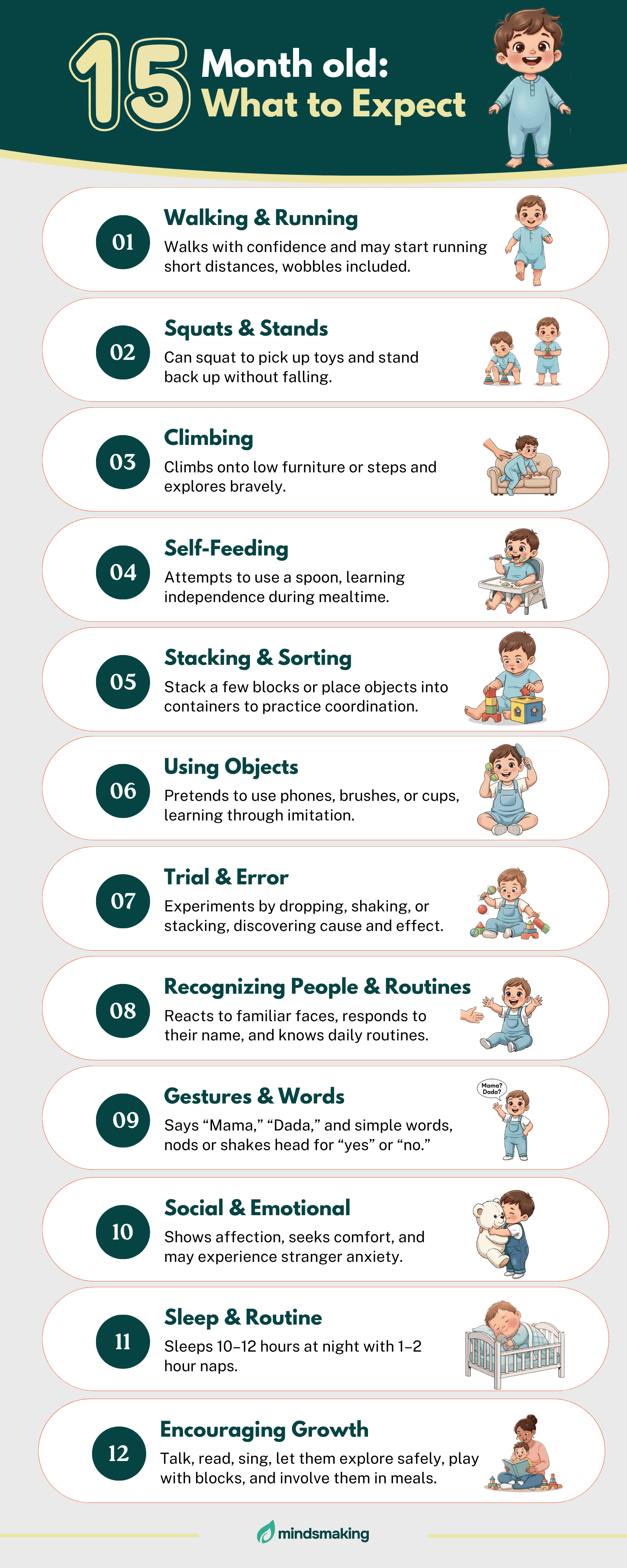
Walking more confidently and starting to run
Those first wobbly steps are now steady and full of purpose. Your baby walks with more confidence and may even try to run, often when you are least prepared. Do not panic when they stumble; it is part of how they learn balance and stability. Their growing coordination and movement show strong motor skills.

Squatting to pick up toys and standing back up
Your baby can now squat down to pick up a toy and stand back up without falling over. This simple action shows strong leg muscles and body control. You will see it most when they drop a toy just to pick it up over and over again because to them, that is real fun.

Climbing onto furniture or low surfaces
Your toddler is now brave enough to climb onto low chairs, couches, or steps. It is a thrilling new skill and a clear sign of growth in their strength and balance. Keep an eye on them, though, because their love for climbing does not always come with a good sense of limits. This is also a good time to make sure furniture is safe and sturdy for their little adventures.

Beginning to feed themselves with a spoon
Mealtime now looks more like a mini display of independence. Your baby wants to feed themselves with a spoon, and while half the food may end up everywhere else, this is still considered progress. It is an important step in fine motor skill development. Keep offering a balanced diet and healthy snacks, and do not worry too much about the mess, as it is part of the learning process.

Stacking a few blocks or placing objects into containers
You will start seeing your baby stack two or three blocks or put toys into containers. This shows real progress in how they handle objects. They might take their stacking very seriously, then laugh as they knock it down just to start again. In their own world, destruction is another form of learning. So, these little actions build patience, control, and focus.
Cognitive Development
Your baby’s brain is developing in ways you might never have imagined at 15 months. To your toddler, everything is now starting to click, unlike when they were a 1-week-old baby, still adjusting to life outside the womb. They are beginning to connect ideas, remember patterns, and understand how one thing leads to another. What once looked like random play is now purposeful exploration. That curious stare, that determined attempt to fit a toy into a box, or that sudden smile is all part of their growing mind working hard to make sense of the world around them.
Here is how your baby's brain is developing now:
Trying to use objects correctly: If you have ever caught your toddler holding a phone to their ear and babbling like they are on an important call, that is cognitive growth in action. They are learning that objects have specific uses and are trying to imitate what they see you do. At this stage, your baby might try to brush their hair, drink from a cup, or feed their favorite stuffed toy. It is not always neat or accurate, but it is a sign of brain development.
Understanding how things work through trial and error: The 15-month milestone is an experimental phase for your toddler. They are always busy testing how the world works. They will drop, push, press, shake, and pull just to see what happens next. That is their way of figuring out cause and effect. It may look like chaos, but to them, it is pure science. Every repeated action, from opening and closing drawers to stacking and knocking over blocks, teaches them how things work.
Recognizing familiar people and routines: Your child’s memory is growing fast. They can now recognize familiar faces and react differently to strangers or loved ones. They also understand routines like heading to the bathroom when you say “bath time” or getting excited when you bring out their shoes for an outing. These small reactions show cognitive maturity and emotional connection.
Showing curiosity and a desire to explore: Your toddler’s curiosity is now a full-time job for both of you. They want to open, touch, and explore everything within reach. This curiosity helps their brain grow faster than ever, and improves their attention, focus, and understanding.
Thinking and problem-solving: Cognitive growth at 15 months also means figuring things out, sometimes in ways that surprise you. Your baby is learning persistence: stacking blocks again after they fall or trying to fit shapes into the right holes. Your child now knows that actions have outcomes, and they will test these outcomes again.
Communication and Language Development
Your 15-month-old is becoming quite the communicator. At this stage, they are not just making sounds, but they are trying to connect with you. You will notice a mix of words, gestures, and facial expressions that could easily fill a toddler drama series. Here is what this stage looks like:
Saying a few clear words: Those first clear words are like music to your ears, even when they repeat “mama” several times in one minute. Do not be surprised if your baby suddenly starts competing for speech with every adult in the house. When your little one says “bye-bye” or “more,” it is not just adorable; it shows they’re beginning to understand communication has meaning. Every word, no matter how short, is a big leap in their speech development.
Using gestures like nodding or shaking their heads: Before full sentences, toddlers let their heads do the talking. A proud headshake might mean, “No, I don’t want,” while a slow nod says, “Yes, I want that toy right now.” These gestures are not random; they show your child understands choices and can express preferences, even if those preferences are mostly snacks and playtime.
Following simple instructions: Hearing your toddler follow a simple instruction feels like winning a small parenting award. You say, “Come here,” and they actually come. You say, “Give it to me,” and for once, they do. Just don't expect a perfect record, because some days, “come here” turns into a fun chase around the living room. It is not defiance; it is your toddler testing independence.
Pointing to show interest or to get attention: When your child points at things like a dog, a toy, or even your snack, they are not just being curious; they are learning how to share their world with you. That little finger means, “Look at that!” or “I want to understand this.” It is their way of saying, “Talk to me about what I see.” So yes, when they point to the fridge for the tenth time, it is communication in progress, not disturbance.
Read This Next
No posts available
Social and Emotional Development
At 15 months, your baby is discovering that the world is full of people, not just toys, snacks, and nap times. They are also learning what it means to love, trust, and belong. You will notice them showing affection and seeking comfort more intentionally. Those tight hugs, random kisses, and snuggles after a tumble are a beautiful reminder that your presence is their biggest source of comfort. Of course, even if they run off two minutes later to chase the cat, their love for you is still rock solid.
Your child now understands their own name and responds when called, though sometimes with selective hearing. You will say, “Come here,” and they will glance at you like they are processing a major life decision. Other times, they will beam, giggle, and run into your arms like it is the best moment of the day. That recognition shows growing self-awareness and emotional understanding. They are not just reacting; they know who they are and that you are talking to them. It’s the start of emotional identity.
As they grow socially, you might notice new waves of shyness or fear around strangers (stranger anxiety) or unfamiliar places. This is not regression, it is emotional growth. They are beginning to tell the difference between what feels safe and what does not.
When they start imitating your everyday activities, either by pretending to sweep the floor or by talking on the toy phone, they are showing empathy and connection. They are basically copying what love and care look like because they have seen it from you. So, when your toddler grabs a cloth to clean the floor you just mopped, just smile. It is not a mess; it is a sign of social and emotional development.
Sleep and Routine
Your toddler is starting to take sleep seriously most nights, at least. You can expect around 10–12 hours of night sleep, with some stretching closer to 13, depending on naps and how busy their day was. Altogether, toddlers this age usually sleep about 11 to 14 hours in 24 hours. Some nights will feel like a dream; others may come with surprise wakings at 2 a.m., because apparently that is prime playtime.
During the day, they usually take one solid nap that can last about 1 to 2 hours. Some toddlers still have two shorter naps before fully switching to one, so do not be surprised if nap time feels like trial and error. That one nap helps them recharge, reset, and prepare for another round of running, climbing, and discovering things you did not even know could make noise.
By now, routine is everything. Toddlers love knowing what is coming next, whether it is meals, naps, or bedtime. It gives them a sense of calm and control. A consistent bedtime routine, like a warm bath, a short story, and a cuddle, works wonders. It signals to their little brain that it is time to wind down.
How to Encourage Development
Your toddler is in a season of discovery, and you can tell in the way they are eager to talk, explore, play, and do everything all by themselves. This is your chance to guide that energy in ways that build confidence, creativity, and connection. From daily chats to messy meals, these small activities make a big difference in how they learn and grow.
- Encourage language by talking to your toddler about what you’re doing, reading picture books together, and singing simple songs.
- Promote independence by allowing safe exploration and letting them make small choices, like picking clothes or toys.
- Stimulate play with building blocks, pretend cooking, shape-matching, and simple puzzles that foster imagination.
- Offer healthy foods and encourage them to self-feed, explore textures, and name the foods they eat.
A Word from Mindsmaking
Your 15-month-old is growing faster than you can blink, always learning, laughing, and surprising you in new ways every day. These moments, from the tiny steps to the new words, are more than milestones; they are memories in the making. Celebrate each one, no matter how small.
Keep observing, interacting, and most importantly, keep enjoying this stage. It is that beautiful mix of wonder and work that defines motherhood. You are doing an amazing job, and your little one is lucky to have you.
Was this article helpful?
How many stars are you giving this article?
Leave a comment
Your email address will not be published.