5-Month-Old Baby Development and What to Expect

Written by Mindsmaking Medical Writer

Fact Checked by Mindsmaking Professionals
15th, December, 2025
Your 5-month-old is growing fast, full of curiosity, giggles, and surprises. Their growth also includes brain and sensory development. So, there are several exciting milestones to look forward to.
By 5 months, your baby is almost halfway to their very first birthday. The newborn days are finally gone, and you now have a baby who is ready to keep you on your toes. At this stage, your baby is more playful, curious, and full of surprises.
Already, your baby's routine will start to feel more predictable. You are getting a clear picture of their sleep and feeding schedule. Even the bedtime routine now feels more familiar. It is one of the sweetest parts of a 5-month-old baby's development.
Right ahead of you are more "firsts" to celebrate. Your 5-month-old baby is growing fast and reaching growth milestones in an exciting way. Knowing what is typical at this stage will help you support their development.
Key Takeaways
At 5 months, your baby is more playful and curious, with routines starting to feel predictable. You can now anticipate feeding, sleeping, and playtime, making daily life a little smoother and more enjoyable.
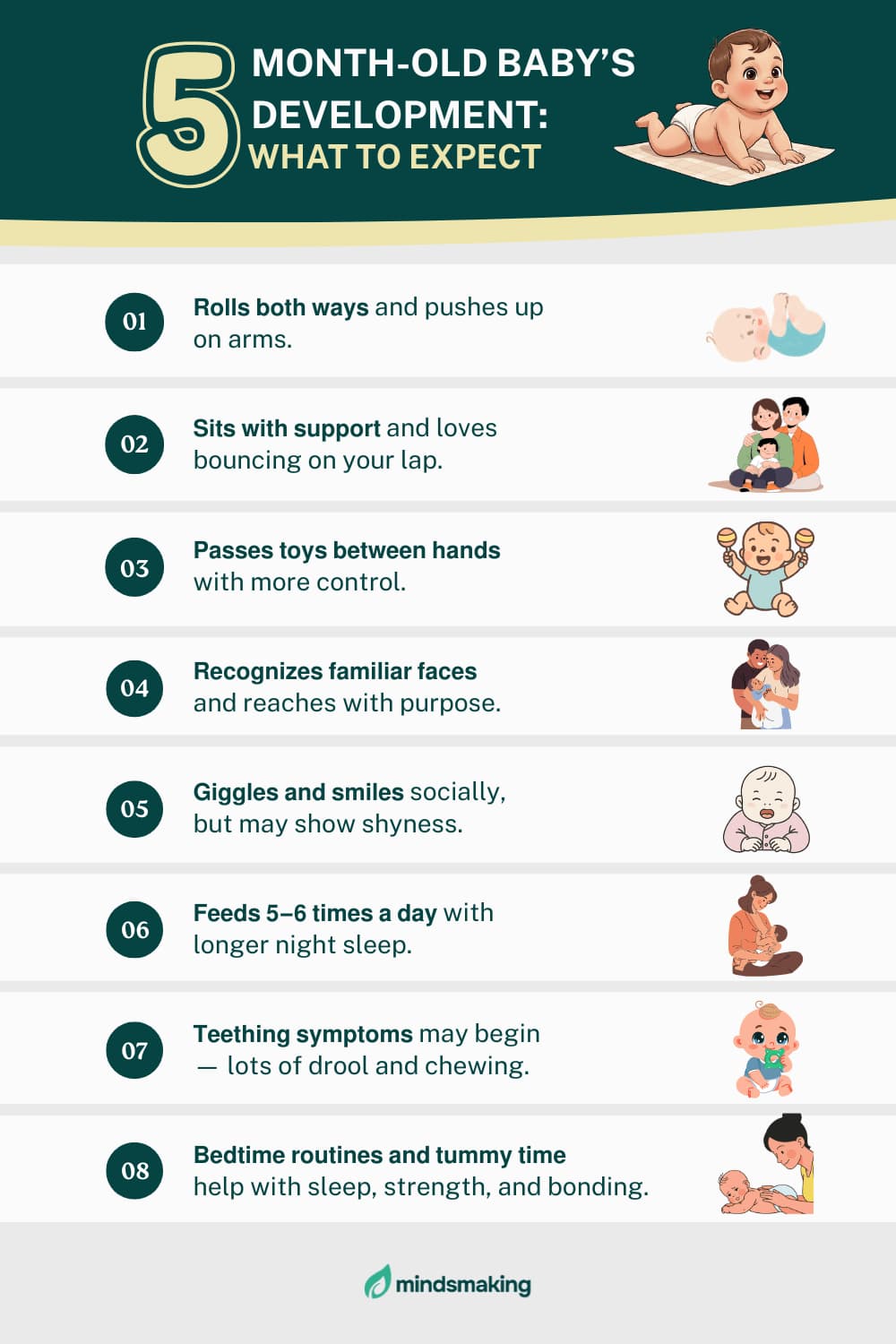
Your baby’s muscles are stronger, allowing them to roll over and sit with some support. These new skills mark exciting progress and prepare them for the next big milestones like crawling and standing.
Cognitive growth is booming as your baby starts recognizing familiar faces and experimenting with sounds. They may babble, giggle, and interact more, showing the first signs of memory and social connection.
Emotional development shines as babies smile more, laugh easily, and express frustration or joy. They bond closely with caregivers and may show shyness around new faces, a normal step in their growing awareness.
Feeding is still centered on breast milk or formula, with most babies needing 24–32 ounces daily. Sleep becomes more regular, with 12–15 hours total split between long nighttime stretches and daytime naps.
Big milestones this month include rolling both ways, sitting with support, and passing toys between hands. Every new movement builds strength, balance, and coordination, setting the stage for crawling soon.
At 5 months, your baby may start teething, exhibiting fussiness, drooling, and a tendency to chew on objects. Vaccines may also be due, and safe sleep practices remain important as your baby grows more mobile and curious.
A consistent bedtime routine helps babies settle and sleep longer. Activities like a warm bath, gentle massage, cuddles, and a story or song send signals that it’s time to wind down and rest peacefully.
Watch for signs of developmental delay, such as not rolling, poor head control, no grasping, or little response to sounds or faces. If you notice these, reach out to your pediatrician for guidance and support.
Physical and Motor Development
At 5 months, your baby is turning into a little explorer. They are stronger, wigglier, and full of surprises. Every kick, roll, and stretch is a tiny victory, and sometimes a mini heart-stopping moment for you. Their muscles are getting stronger, their movements are more intentional, and their curiosity is off the growth charts. It is the perfect mix of adorable, harmless chaos and proud parent moments. Here is what you can expect during this exciting stage.
Physical and Motor Development

Rolling Skills
Your baby can roll from tummy to back and may even start rolling from back to tummy. Each roll is a mini-celebration, showcasing stronger muscles and improved coordination.

Head and Chest Control
During tummy time, they can lift their head high and push their chest up using their arms. This builds neck, shoulder, and core muscles, which are essential for sitting, crawling, and future adventures.

Supported Sitting
Your baby can now sit with support, using their arms to balance. This milestone makes it easy to cheer your baby loudly. Yes, you can call everyone in the house to witness this tiny triumph.

Hand and Leg Coordination
Movements are now purposeful and strong. Your baby can grasp toys, pass objects from one hand to the other, and explore by mouthing objects. When held
Cognitive and Social Development
At 5 months of age, your baby is becoming increasingly social and undergoing significant brain development. This little chap of yours is getting wiser, learning daily, and finding new ways to interact.
As your newborn is developing, their memory is also getting better. They can now recognize familiar faces and objects. Amazing right? Their brain is starting to understand object permanence, that objects exist even when they do not see them. Again, when your baby shakes a toy, for instance, and it makes a sound, it sends a message to their brain. From this, your baby is learning that cause is an action and effect is the sound from the toy. Before you know it, they will start repeating this action for the same effect.
Now, your baby is mostly playing with babbling and sounds. It is like a sound experiment that is fun to make for your 5-month-old baby. In fact, they sometimes change their pitch as if they are trying out something new. During breastfeeding or bottle feeding, they are watching your face closely to show curiosity. Yes, your baby is already socializing in their own little ways. If you call their name, they may turn to you and smile or laugh. They also have ways of communicating with you. They may lift their arms up to show they want you to carry them or cry when you are about to leave the room.
Emotional Development
Even your 5-month-old baby can show love, joy, anger, boredom, or frustration in their own little way. Every bit of their actions is now communicating their emotions. After playing with a toy for a while, they may drop it to show boredom. The only thing they never get tired of is your face and company.
Your 5-month-old baby is smiling, laughing easily. They may vary their cry to be loud when they are frustrated or angry. Since you spend more time with them, they feel more attached to you. They also bond with caregivers and familiar faces, but may take time before relating with unfamiliar faces. They are aware that the faces are strange and do not want to jump into interactions. These are normal baby developments and should not be a cause for concern.
Read This Next
No posts available
Feeding and Sleeping Patterns
If anything is constant in your baby's life, it has to be food and sleep. Your baby still needs to be fed and sleep well for better development. At 5 months, your baby's favourite food is still breast milk or formula. This should be given 5 to 6 times a day (24 to 32 ounces per day) to both breastfed and formula babies.
Sleep and food work hand in hand in your baby's development. Your baby needs a total of 12 to 15 hours of sleep in a day at 5 months old. This includes 10-12 hours of nighttime sleep and 2-3 daytime naps. Your baby has now started sleeping in longer stretches but may still wake up for night feeds, especially breastfeeding babies.
If your baby is staring at your plate at 5 months old, blame it on development. It is because they are gradually getting closer to the solid food stage. Most parents may consider weaning at 5 months to start solids, but this is best when your child reaches the 6-month-old milestone. You may actually notice early signs of solid food readiness. Once your baby starts sitting with minimal support, they may be ready, but this alone does not necessarily mean they are ready. Other signs include steady head control while in the sitting position, the ability to pick up objects and put them in the mouth, and leaning forward to reach for your food. They may also open their mouths when food appears in front of them with a spoon.
Common Health Considerations
At 5 months, your baby is growing fast, and with all that growth comes a few new health and safety considerations to keep in mind. Teething often starts around this age, and yes, it can make your baby a little fussier than usual. Drooling, swollen gums, and chewing on everything in sight are all part of the 5-month-old baby's development. You can help soothe their sore gums by gently rubbing them with a clean finger. Chilled purees can work wonders too. Expect a few extra cries and clingy moments when your child is teething. Always consult your pediatrician before giving any medication for teething discomfort.
Vaccinations are another big milestone for your 5-month-old baby. At this stage, your baby may be due for vaccinations such as DTaP, IPV, Hib, PCV, and rotavirus. These protect them from serious illnesses and strengthen their immune system. Your healthcare provider can confirm the exact schedule so your baby stays on track.
Safe sleep practices are just as important to keep your baby healthy. Always place your baby on their back to sleep on a firm, flat mattress, and keep pillows, blankets, stuffed animals, or toys out of the crib. This helps reduce the risk of accidents and gives you a little peace of mind. As your baby becomes more curious and mobile, start baby-proofing your home by anchoring furniture, covering outlets, removing small objects, and installing gates where needed. With routines becoming more predictable, you will find small moments of rest while your baby continues to give you those “Wow!” moments.
Routine Tips
At 5 months, your baby is becoming more interactive and curious about the world around them. Establishing a consistent daily routine can help support their growth and development. Here are some routine tips to consider
Consistent Bedtime Routine: Establish a calming pre-sleep routine to help your baby wind down. This might include a warm bath, a gentle massage, cuddling, and reading a short story. Consistency helps signal to your baby that it is time to sleep, and this also promotes better rest.
Daily Tummy Time and Floor Play: Continue to engage your baby in tummy time sessions to strengthen their neck, back, and shoulder muscles. This activity supports growth milestones, such as rolling and crawling. Incorporate floor play with soft toys to encourage reaching and grasping, which improves your baby's motor skills.
Provide Toys for Grasping and Hand-Eye Coordination: Offer age-appropriate toys that encourage your baby to reach, grasp, and manipulate objects. This supports the development of hand-eye coordination and fine motor skills.
Include Reading, Singing, and Interactive Play: Engage your baby with simple board books, sing songs, and play interactive games like peek-a-boo. These activities stimulate cognitive development, language skills, and strengthen your bond.
Include Reading, Singing, and Interactive Play: Engage your baby with simple board books, sing songs, and play interactive games like peek-a-boo. These activities stimulate cognitive development, language skills, and strengthen your bond.
Development Problem Signs
Every baby develops at their own pace, but noticing certain delays early can help you get the support your little one needs. Reach out to your child’s doctor if your baby shows any of the following signs
- Your baby does not have steady head control during tummy time or when sitting with support.
- Your baby cannot roll in either direction, from tummy to back or back to tummy.
- Your baby is not reaching for or grasping objects intentionally.
- Your baby is not making sounds or attempting to babble, such as “ba-ba” or “da-da.”
- Your baby shows little or no response to familiar voices or faces with smiles or head turns.
Was this article helpful?
How many stars are you giving this article?
Leave a comment
Your email address will not be published.