11-Month-Old Baby Development and What to Expect

Written by Mindsmaking Medical Writer

Fact Checked by Mindsmaking Professionals
24th, November, 2025
The best part of having an 11-month-old baby is watching them claim their independence in little ways. You can see it in how they crawl, pull up, stand, and even take their first steps.
By 11 months, your baby is just a step closer to the most anticipated 1-year milestone. Can you believe it? This is not just about numbers, but about how your little one has grown right before your eyes. Their movements, sounds, and interactions are now almost impossible to miss.
At this stage of an 11-month-old baby’s development, your little explorer is no longer comfortable staying in one spot like they were in the womb. They are crawling, standing, moving faster, and testing their independence at every chance. Suddenly, everything at home becomes fair game for investigation.
Their personality, communication, and mobility have grown even more than what happens in their 10-month-old baby's development. Now, it is important to remember that every baby develops at their own pace. What matters most is noticing common baby milestones, celebrating each small victory, and knowing when to seek support.
Key Takeaways
Your 11-month-old is gaining strength, balance, and confidence; pulling up, cruising, and exploring with growing coordination as they prepare for those exciting first steps.
Curiosity and problem-solving are soaring at 11 months, with your baby exploring, imitating, and testing cause and effect while soaking up every new experience.
At 11 months, your baby is balancing independence and attachment, showing preferences, expressing emotions, and enjoying interactive play while learning to navigate their social world.
By 11 months, your baby is experimenting with sounds, gestures, and expressions, starting to understand words, follow simple instructions, and communicate clearly with familiar people.
At 11 months, your baby is exploring solid foods while still relying on breast milk or formula, practicing self-feeding, trying new textures, and learning to drink from a cup.
At 11 months, your baby typically sleeps 10–12 hours at night with two naps, and a consistent bedtime routine with gentle wind-down activities helps manage separation anxiety and support healthy development.
Encouraging an 11-month-old’s development involves providing safe spaces for exploration, engaging in daily conversations and play to enhance communication, offering toys that build skills, celebrating milestones, and gently fostering independence.
If your 11-month-old is not moving, babbling, showing interest in people, using gestures, or has lost skills they once had, it is important to trust your instincts and consult a doctor.
Physical and Motor Development
Your 11-month-old baby is practically on the move all day, and honestly, you might be wondering where all that energy comes from. This stage comes with exciting progress in physical development. Their muscles are growing stronger, their balance is improving, and their coordination is definitely getting better. You will see major improvements in gross motor skills. Every move now feels intentional, and certainly, a lot is happening right before you. Here is what this stage looks like:
Physical and Motor Development

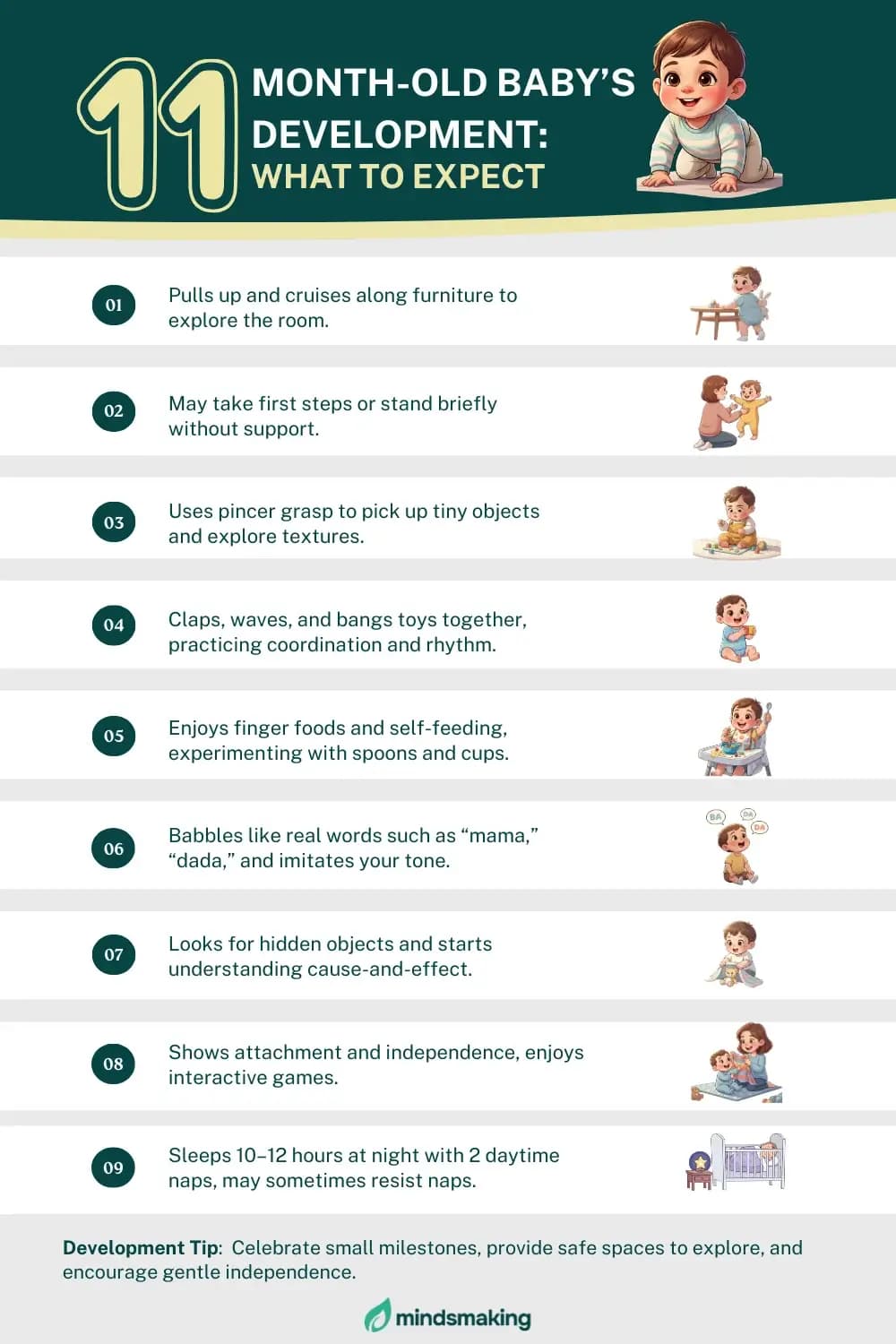
Pulling up to stand
Your baby now loves pulling up on anything. This could be a sofa, chair, or even your leg. Standing tall gives them a whole new view of the world, and you can almost see the pride on their little face every time they manage to get up.
Cruising along furniture
Many 11-month-olds are learning to move sideways while holding onto furniture for balance and stability. It is their way of rehearsing for walking. You might even catch them pausing and laughing for applause after a few steps, as if to say, “Did you see that?”

Taking first steps or standing briefly without support
Some babies may take those magical first steps this month, while others might just stand on their own for a few seconds before gracefully falling back on their diaper.

Improved hand-eye coordination
Your baby’s fine motor skills are now impressive. They can pick up tiny objects using the pincer grasp (thumb and forefinger), transfer items from one hand to another, and explore textures with intense curiosity. Somehow, that also means anything on the floor, from crumbs to buttons, becomes a fascinating snack. So, stay watchful of what goes into your baby's mouth.

Clapping, waving, and banging toys together
These simple actions are a huge win for coordination and rhythm. Expect lots of claps, waves to anyone who looks their way, and endless banging of toys. It can be noisy and chaotic, but there is also development taking place.

Developing self-feeding skills
Finger foods are the highlight of mealtime. Your baby is learning to feed themselves, though the floor might be getting more of the meal than their mouth. They may even start experimenting with spoons or cups. It is worthy to note that all children do not develop at the same pace, and walking can happen anytime between 12–14 months, so do not panic if your little one is not there yet. What is important is that they are moving, exploring, and getting stronger every day.
Cognitive Development
At 11 months, your baby's brain is now working overtime, connecting ideas, exploring how things work, and learning from every moment. You will notice them becoming more curious, expressive, and determined to figure everything out on their own, even when it means emptying the drawer you just arranged. Here is what cognitive development looks like this month:
Stronger problem-solving skills: Your baby is beginning to understand how things work. They might press a button to make a sound or figure out how to open a lid to get what is inside. Every move seems like a little experiment, and when they succeed, the look of pride on their face is priceless. Of course, when it does not work, expect a tiny frown and maybe a dramatic sigh. Apparently, trial and error is exhausting work for your baby.
Imitates simple actions: Copying you has become one of their favorite games. You will notice them pretending to brush their hair, talking on a toy phone, or even helping with chores. This imitation stage is more than just adorable, it is how they learn. So yes, when they mimic you, just remember it is part of their 11-month-old baby milestones.
Look for hidden objects: If you hide a toy under a blanket, they will go searching for it like a little detective. This shows that they now understand object permanence, the idea that things still exist even when out of sight. So, hiding your keys or the remote will no longer work because they now know your tricks.
Start matching cause and effect: Dropping toys to watch them fall or splashing water to see what happens is your baby's way of testing cause and effect. They are now fully invested in understanding actions and reactions. Of course, this also means you will pick up the same toy twenty times a day, but it is all in the name of learning.
Short attention span but increasing curiosity: Their focus may shift faster than you can say “peekaboo,” but their curiosity is blossoming. They love turning objects around, shaking them, stacking them, or dropping them into containers just to see what happens next. It is a beautiful sign of their growing intelligence.
Social and Emotional Development
Your baby’s emotional world is growing fast at 11 months of age. They are learning to connect, express feelings, and show independence while still needing reassurance from their favorite people. Definitely, they are also developing socially and emotionally.
- Your baby becomes more independent, but still turns to you for comfort when things feel uncertain, because you are their safe place after all.
- Your baby shows a preference for familiar people and may act shy around strangers (stranger anxiety). It is their way of feeling safe and protected.
- Your baby begins to assert will with a few mini tantrums when things do not go their way. This is a tiny taste of the toddler stage ahead.
- Your baby responds happily to praise and loves games like peekaboo and pat-a-cake that make them feel noticed and loved.
- Your baby understands simple routines and enjoys participating in family activities, from clapping during dinner to snuggling during storytime.
Read This Next
No posts available
Communication and Language
By 11 months, your baby’s voice is becoming one of your favorite sounds, even when it is just a stream of babbles that only they seem to understand. Communication at this stage is all about experimenting with sounds, tones, and expressions, and honestly, they are doing a pretty good job of running the household conversation already. Here is how your 11-month-old baby is communicating at this stage:
Babbling starts sounding like real words: You will hear a lot of “mama,” “dada,” and “baba,” sometimes used perfectly, other times at random. Either way, it is music to your ears, and yes, even if they call the dog “mama,” just take the win.
Mimicking your tone and words: Your little chatterbox now loves copying how you speak. Say “uh-oh,” and they will try to match your pitch perfectly. Of course, sometimes their version sounds like a foreign language, but that is all part of the fun.
Understanding simple instructions: When you say “come here” or “give me the toy,” you might notice they actually respond. It is one of those magical moments when you realize they truly understand you, even if they may choose not to listen to you.
Responding to their name and recognizing familiar voices: Your baby can now turn to you when you call their name and beam when they hear your voice from across the room. Strangers may still get curious stares, but your voice is home for them.
Using pointing, gestures, and facial expressions to communicate: Babies at this age talk a lot, just not always with words. They will point to things they want, wave to say hello or goodbye, and give you that “feed me now” look that says it all.
Food and Nutrition
Your baby’s appetite is growing right along with their personality at 11 months. They are eating more, making a food mess, and giving you looks that clearly say, “I can do it myself.” At this stage, your little one can enjoy three small meals and two snacks each day. The key is balance with small portions of fruits, vegetables, grains, and proteins that are soft and easy to chew. You may give them mashed potatoes, steamed carrots, rice, and soft fruits like bananas. You will probably notice that some foods end up on the floor or in their hair, but that is just their way of expressing themselves.
Finger foods are a big deal right now because they help your baby practice independence. Whether it is picking up bits of toast or self-feeding with chubby fingers, every grab and drop is a victory. Continue offering breast milk or formula until their first birthday, as it remains their primary source of nutrients while solid foods take center stage. As you introduce more food textures, do not be afraid to let them explore, but always be watchful.
Encourage cup drinking by introducing a sippy cup or straw cup. Some babies get the hang of it quickly, while others chew the straw like it is a toy, and that is perfectly fine. Continue offering it with water or a small amount of milk to help them transition smoothly. While variety is great at this point, there are still a few foods that should stay off the menu for now.
Foods to avoid
- Honey (risk of infant botulism)
- Whole nuts and uncut grapes (choking hazard)
- Added salt and sugar (too harsh for their system)
- Cow’s milk should not be given as a main drink until after 12 months
- Unpasteurized milk, cheese, or juice
- Sugary drinks, sodas, and processed snacks
- Fish high in mercury, such as shark or swordfish
- Popcorn, raw carrots, or hard apple chunks
- Sticky candies or thick nut butter
Sleep and Routine
Sleep plays a big role in your 11-month-old baby’s development, even if your little one sometimes acts like it is optional. Around this age, babies typically sleep 10 to 12 hours at night and take two naps during the day. With all the excitement of crawling, standing, and exploring every corner, they may start to resist naps. It is all part of their growing independence and curiosity about the world.
Creating a calm and predictable baby routine can make a significant difference. A consistent sleep schedule helps your baby understand when it is time to rest. Try winding down with gentle baby activities, such as cuddling, singing lullabies, or reading a short story. These small moments not only relax them but also strengthen your bond before bedtime.
Of course, separation anxiety can make nights a little tricky. Your baby might fuss or reach for you the moment you walk away, which is completely normal at this stage of development. Offer comfort through a soft touch, a calm voice, or simply staying nearby until they settle. Over time, these comforting habits help your baby feel secure and make bedtime smoother for both of you.
How to Encourage an 11-Month-Old’s Development
Encouraging your 11-month-old baby’s development is all about creating moments that let them explore, move, and learn at their own pace. At this stage, your little one is becoming more confident with every step, sound, and gesture. Although tummy time is no longer the main focus, it remains beneficial for maintaining muscle strength and supporting balance as they prepare to walk and climb.
- Offer safe spaces to practice standing and cruising. Clear a soft, open area where your baby can pull up, move along furniture, and test their balance without you panicking.
- Talk, sing, and read daily. Describe what you are doing, name objects around the room, and sing your favorite nursery rhymes.
- Play interactive games to strengthen communication. Peekaboo, pat-a-cake, or simply “Where’s your nose?” games make learning fun.
- Provide stacking toys, blocks, and cause-and-effect toys. These encourage problem-solving, fine motor skills, and curiosity.
- Celebrate small milestones with smiles and claps. Your excitement gives them confidence to keep trying.
- Encourage gentle independence. Let your baby hold their spoon, pick up finger foods, or try putting on their hat.
Development Problem Signs
If your 11-month-old baby’s development feels a little stuck, it is fine to pause and take a closer look. Trust that gentle voice inside you that says something does not seem right because no one knows your baby better than you do. Definitely, some signs are worth bringing up with your doctor.
- Your baby is not crawling, pulling to stand, or putting weight on their legs.
- Your baby does not babble, make sounds, or respond to their name.
- Your baby does not show interest in people or play.
- Your baby feels too floppy or unusually stiff when moved.
- Your baby shows no interest in feeding themselves or exploring.
- Your baby does not use gestures like waving, pointing, or shaking head.
- Your baby is not trying to communicate their wants.
- Your baby has a sudden loss of skills they previously had.
Was this article helpful?
How many stars are you giving this article?
Leave a comment
Your email address will not be published.