10-Month-Old Baby Development

Written by Mindsmaking Medical Writer

Fact Checked by Mindsmaking Professionals
1st, December, 2025
At 10 months, your baby is growing faster, gaining more weight, and learning new ways to approach life. From crawling to standing tall, your 10-month-old is full of energy and curiosity. Here’s what to expect from your 10-month-old.
In the 10th month of birth, your baby is already showing off their growth in so many ways. You can tell by how they are becoming more independent, from trying to hold the spoon during meals to adjusting their own sleep routine like an adult. They are also moving all around the house, even more than during their 9-month-old baby’s development.
Honestly, this is the time to be more watchful because your baby is now a curious little chap, always looking for answers to new problems. You will notice them pulling, poking, and exploring everything within reach. Of course, that includes things you would not want them to touch.
At this stage, development seems to happen faster than ever, and you may find yourself rolling from one amazing moment to another. It is a wonderful time to pause, enjoy, and cherish every milestone from smiling to laughing, sitting, crawling, standing, and walking.
Key Takeaways
At 10 months, your baby is mastering movement, balance, and coordination through activities such as pulling, cruising, developing fine motor skills, and self-feeding, laying the foundation for walking and independent exploration.
By 10 months, your baby is rapidly developing memory, curiosity, and problem-solving skills while understanding simple words, exploring cause and effect, and imitating daily routines.
Your baby is forming strong attachments at 10 months, showing a wide range of emotions, exploring independence, and beginning self-awareness while navigating separation and stranger anxiety.
Around 10 months, your baby communicates with purposeful babbling, gestures, early words like “mama” or “dada,” responds to familiar phrases, enjoys songs and rhymes, and is beginning to take turns in mini conversations.
Your 10-month-old relies on breast milk or formula while exploring soft finger foods, varied textures, and iron-rich options, practicing self-feeding and cup drinking, while avoiding choking hazards and unsafe foods for healthy growth.
Your 10-month-old sleeps 10 to 12 hours at night with one or two naps, thrives on a calm bedtime routine, and may wake occasionally due to separation anxiety or teething.
Encouraging standing, exploration, interactive play, and responsive communication helps a 10-month-old build strength, coordination, language, and confidence.
Regular checkups, baby-proofing, and keeping small objects and floors safe help protect a curious 10-month-old as they crawl, pull up, and explore.
A lack of babbling, limited movement, poor eye contact, or loss of skills in your baby may be developmental concerns and should prompt a pediatric consultation.
Physical and Motor Development
Your 10-month-old baby’s development is reaching a whole new level of motion and excitement. You can almost see the confidence in their steps, or rather, their wobbly little attempts at standing. This month, your baby is all about strength, movement, and control. Here is what your 10-month-old's physical and motor development looks like:
Physical and Motor Development

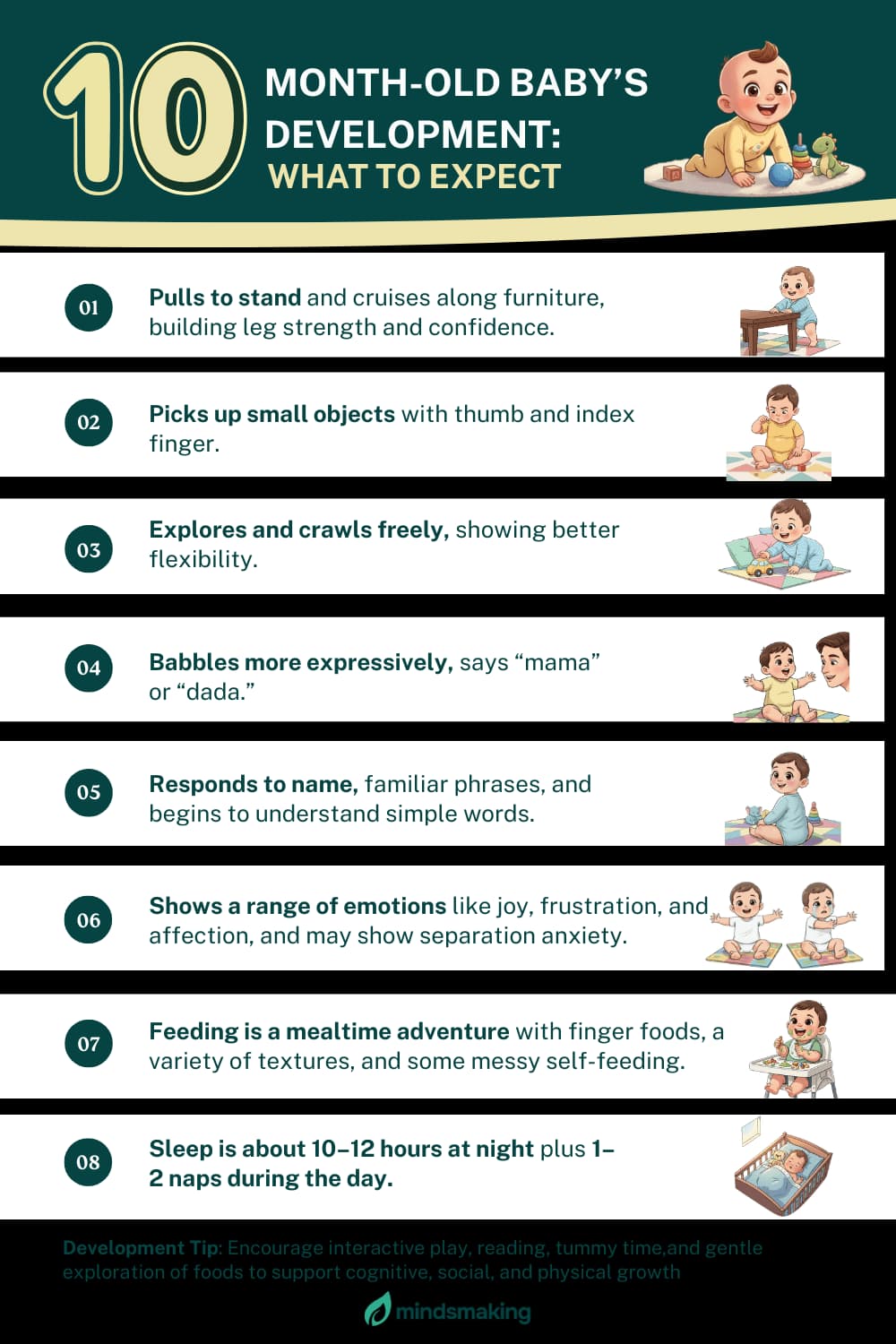
Pulling to stand, cruising, and supported steps
Your baby is becoming quite the little adventurer. They are pulling up to stand, holding onto furniture, and cruising from one spot to another. Some may even take supported steps while holding your hands. Each movement builds muscle strength, balance, and the courage to take that big first step soon.

Developing a stronger pincer grasp
Your baby is now using their thumb and index finger together to pick up small objects. Whether it is a piece of food or something they should not have picked, this fine motor skill shows how quickly their coordination and focus are improving.

Better hand-eye coordination
You will notice your baby clapping, waving, or pointing at things they want. These playful gestures are signs of growing hand-eye coordination and better muscle control. It is also your baby’s way of showing how much their physical awareness is developing.

Growing interest in self-feeding
Mealtime has now turned into an adventure, and a bit of a mess at 10 months. Your baby is eager to feed themselves, explore food with their fingers and practice how to hold a spoon. It may be messy, but it is an important part of those baby activities that build independence and confidence.

Movement transitions and flexibility
Your baby can now shift easily from a sitting position to crawling or from crawling to standing without assistance. These smooth transitions show growing flexibility and control as your little one learns to move more freely and confidently.

Improved balance and stability control
Every time your baby pulls up, bends, or reaches for something, they are practicing how to steady themselves. Their balance and stability are improving. This is helping them stay upright longer and recover more easily from falls. These repeated movements strengthen core muscles and improve coordination.

Reflexes and re-emergent behaviors
Some early reflexes, like stepping or grasping may reappear in new ways as your baby experiments with movement. These re-emergent reflexes serve an important function. They help the brain and muscles work together to refine movement, improve balance, and prepare for complex motor skills such as walking and climbing.
Cognitive Development
At 10 months, your baby is taking a huge step in thinking and understanding every little thing. You can almost see their little brain at work as they explore, remember, and copy the world around them. This is the stage where curiosity truly meets discovery. Here is what your 10-month-old baby's development looks like:
Understanding of simple words like “no” or “bye-bye”: At this stage, your baby is starting to understand simple everyday words. When you say “no,” they might pause, frown, or give you that look that says, “I hear you, but I’ll still try.” Also, when you say “bye-bye,” you may get a wave or a giggle in return. It is one of the first signs that your baby’s communication and understanding are developing beautifully.
Explores cause and effect: If your baby keeps dropping a spoon during feeding time or lets go of their toy just to watch you pick it up, do not worry. That is not intentional mischief, it is learning. They are testing cause and effect, a major part of baby development. This playful repetition helps them understand that their actions can create reactions.
Stronger memory and curiosity: When your baby starts looking for a toy you have hidden under a blanket, it is a big step in their development. This means they now understand object permanence, which is the concept that things still exist even when they cannot be seen. It is a clear sign of cognitive growth and stronger memory. You will also notice more curiosity as they search, peek, and crawl around just to find what interests them.
Imitation: This is the month your baby turns into a little copycat in the cutest way possible. They might hold a brush to their head or a toy to their ear like a phone. This is a way of imitating what they have seen you do. Your baby’s growing memory allows them to copy actions even after some time has passed. They might see you clap in the morning and do the same thing later in the day. This deferred imitation is an impressive sign of cognitive maturity and stronger recall.
Learning through exploration: At 10 months, your baby is learning by exploring things. Every shake, bang, or pull is part of your baby’s research. Whether they are pushing buttons, dropping blocks, or spinning objects, they are experimenting how things work. This practice helps them improve logical thinking.
Improved attention and focus: Your baby can now stay focused on a toy or activity for longer periods. You will notice them studying objects closely, turning, shaking, or stacking them. This growing attention span supports better learning and prepares them for more complex baby activities ahead.
Recognizing routines and anticipating events: By now, your baby is beginning to predict what comes next. They might crawl toward their high chair at feeding time or get excited when they hear bath water running. Recognizing daily patterns gives them a sense of security and helps strengthen their understanding of time and order.
Social and Emotional Development
Your 10-month-old baby’s development is now full of little emotions that can completely impact your day. From wide smiles to sudden tears, or those hearty giggles that melt your heart, every reaction shows that your baby is growing emotionally. This month, your little one’s social and emotional growth is not left out, and here is what to expect:
- Your baby has formed a strong bond with you and may cry or cling when you leave the room. This separation anxiety is a healthy sign of attachment and trust.
- Games like peekaboo and clapping hands are now their favorites. These little activities teach your baby that even when faces disappear, they come back, just like you do.
- You will notice a wide range of emotions like joy, frustration, and affection. This shows how your baby is learning to express and manage feelings.
- Your baby’s sense of independence is growing. They may try to feed themselves, crawl away during diaper changes, or explore places you didn’t know existed.
- Stranger anxiety may appear around this time. Your baby now recognizes familiar faces and may check your expression before reacting to new people.
- Your little one is beginning to recognize their reflection in the mirror, smiling or reaching out to it. This is the start of self-awareness.
Read This Next
No posts available
Communication and Language
At this stage of your baby’s development, communication is becoming more fun and meaningful. You will notice how your little one now talks with purpose, from babbling with excitement to copying your tone when you speak. Every sound is a step closer to real conversation. Here is how your baby is communicating at 10 months:
- Your baby may now say “mama” or “dada” and actually mean it.
- Babbling has become more expressive, with sounds like “ba,” “ga,” or “da” used to get your attention or share excitement.
- Gestures such as waving, clapping, and pointing are now part of your baby’s way of communicating before real words emerge.
- Your baby understands familiar phrases like “bye-bye,” “no,” and “come here,” and may respond with a smile, pause, or quick movement.
- Music and rhymes bring joy, your baby loves hearing songs, playful rhymes, and your soft voice during the daily routine.
- You might catch your baby copying your tone or trying to repeat a word.
- Common words like “cup,” “ball,” or “sleep” are starting to make sense. Your baby may look at or reach for what you mention.
- During feeding or play, your baby points to what they want, which shows how gestures and sounds now work together in communication.
- Your baby is beginning to understand how to take turns during mini conversations; your baby babbles, you respond, and they reply with another sound or laugh.
- Your baby may use consistent sounds or approximations to refer to objects or needs. e.g, ba for a bottle.
Food and Nutrition
By the 10th month, your baby’s feeding time has become a full-blown adventure. One moment, they are chewing happily, and the next, they are decorating the high chair with mashed banana. Do not be surprised if more food ends up on the floor than in their mouth. It is all part of your 10-month-old baby’s development. Each spill, grab, and bite is helping your baby learn independence and coordination. Here are a few things to note this month.
- Continue breast milk or formula as your baby’s main source of nutrition while solids complement their diet.
- Encourage soft finger foods like mashed sweet potatoes, ripe banana slices, or small pieces of well-cooked vegetables to help your baby practice self-feeding
- Introduce a variety of textures like mashed, diced, or pureed foods, so your baby learns to chew and enjoy different flavors.
- Offer iron-rich foods such as mashed beans, lentils, egg yolk, or soft chicken to support healthy growth and weight gain.
- Include fruits and vegetables to boost immunity and support teething development. Soft carrots, avocados, or apples are great choices.
- Give three main meals and one or two snacks per day, along with breast milk or formula, to build a simple and flexible baby routine.
- Let your baby practice drinking from a small cup, it might be messy at first, but it’s a big step toward independence.
- Watch your baby’s cues during feeding as turning away, playing with food, or losing interest means they are full.
- Always sit your baby upright while feeding and stay close. It is safer and turns mealtime into bonding time.
Foods to Avoid
- Honey can cause infant botulism
- Whole nuts, popcorn, or raw vegetables, as they pose choking hazards
- Whole grapes, always cut them into tiny pieces
- Foods with added salt, sugar, or artificial sweeteners.
- Cow’s milk (as a drink), plain cow’s milk is not recommended before 12 months.
- Unpasteurized dairy products or soft cheeses made with raw milk may contain harmful bacteria, such as Listeria.
- Undercooked or raw eggs, raw meat, poultry, fish, and shellfish can cause foodborne illness.
- Sticky, gummy, or hard candy, marshmallows, and chewing gum are choking hazards.
- Caffeinated drinks, sodas, and energy drinks are not safe for infants.
Sleep and Routine
By the 10th month, your baby’s sleep pattern is finally starting to make sense. They now sleep about 10 to 12 hours at night and take one or two naps during the day. Of course, there will still be days when they decide naps are overrated or when bedtime feels more like a friendly debate than a routine.
A calm, predictable bedtime routine works wonders. Try a warm bath, a gentle massage, soft pajamas, a cuddle, and that lullaby that’s slowly becoming your family’s nightly anthem. These little routines help your baby wind down and understand that bedtime is near, even if they sometimes choose to negotiate it.
Do not be surprised by the occasional night waking. Separation anxiety or teething can make your baby crave extra comfort in the middle of the night. When that happens, a gentle pat or soft whisper can make all the difference. This phase will not last forever, and one day, you might even find yourself missing these quiet, sleepy moments together.
How to Encourage a 10-Month-Old Baby's Development
Your 10-month-old is full of energy, curiosity, and determination. This is the time to cheer them on as they try new things. Every move they make is a step toward independence, and your encouragement can go a long way in their development.
Here is how to support your 10-month-old’s development:
- Encourage your baby to stand and cruise along furniture to build balance and leg strength.
- Create safe spaces for exploration because every crawl, pull, and reach sharpens their confidence.
- Talk and sing during daily routines; your voice helps language and emotional development.
- Respond to your baby’s sounds and babbles to teach them that communication goes both ways.
- Offer interactive toys, such as stacking blocks or shape sorters, to improve coordination and problem-solving skills.
- Read colorful picture books and name familiar objects aloud to build memory and word recognition.
- Celebrate every little milestone with a clap, a smile, or a “yay!” This can mean the world to your little explorer.
Common Health and Safety Tips
By 10 months, your baby is on the move, crawling, pulling up, and exploring every nook and cranny like a tiny adventurer. While their curiosity is heartwarming, it also means your home needs to be a fortress of safety. Here is how to keep your little explorer safe and sound:
Stay on top of routine checkups and milestone reviews: Regular visits to the pediatrician ensure your baby's growth and development are on track. It is also a great opportunity to discuss any concerns or questions you might have.
Begin baby-proofing your home: Secure furniture to prevent tip-overs, cover outlets to avoid electrical hazards, and remove choking hazards like small toys or household items.
Watch for small objects that can fit in the mouth: Babies at this age love to explore by putting things in their mouths. Keep small items, like coins, buttons, or small toy parts, out of reach to prevent choking.
Keep floors clean: As your baby crawls and explores more freely, ensure the floors are free from harmful objects, dirt, or pet hair that could pose a risk.
Development Problem Signs
At 10 months, your baby is likely becoming more active, curious, and communicative. However, if you notice certain behaviors or a lack of development, it may indicate potential concerns. While every child develops at their own pace, it is essential to monitor specific signs that may indicate developmental delays.
- Your baby does not babble or respond to their name
- Your baby cannot sit without support
- Your baby shows little interest in people or toys
- Your baby rarely moves, reaches for objects, or explores the world around them.
- Your baby does not make eye contact or follow moving objects with their eyes.
- Your baby does not smile or show facial expressions.
- Your baby does not respond to sounds or voices.
- Your baby uses one hand significantly more than the other.
- Your baby has difficulty with feeding or struggles with solid foods
- Your baby has lost previously acquired skills.
Was this article helpful?
How many stars are you giving this article?
Leave a comment
Your email address will not be published.