9 Effective Labor Positions to Ease Pain and Support Birth
Maridav


Written by Mindsmaking Medical Writer

Fact Checked by Mindsmaking Professionals
16th, October, 2025
Labor positions play a key role in making birth more comfortable and effective. Understanding how movement, posture, and support help your baby descend can ease pain and boost progress throughout labor.
When it’s time to welcome your baby, how you position your body can make a big difference. Labor positions are simply the ways you move, stand, squat, or rest during childbirth, and each one can help ease discomfort, encourage your baby’s descent, and make contractions more effective.
There’s no single “right” way to give birth, what matters most is listening to your body and finding what feels best for you in the moment.
Whether you are swaying on your feet, kneeling, or lying on your side, your body knows how to guide your baby into the world, so trust its wisdom, as every movement and breath is part of a powerful rhythm designed to bring your little one safely into your arms.
Key Takeaways
Different labor positions help ease pain, open the pelvis, and make contractions more effective, and each stage may require a different position.
Some positions, such as rocking, squatting, leaning forward, kneeling, side-lying, lunging, swaying, standing, and deep breathing, support progress and comfort.
You should ask for help or adjustments if you feel tired, dizzy, uncomfortable, or if a position isn’t working, so labor can progress safely and comfortably.
Why Labor Positions Matter
Let’s be honest, when those contractions start to hit, you are probably not thinking, “Which position best optimizes pelvic alignment?” However, the way you move during labor can truly shape your experience. Each shift, sway, or squat is your body’s way of teaming up with gravity to make birth smoother, faster, and a little more comfortable.
Upright or forward-leaning positions help your baby move down naturally, while rocking, standing, or kneeling can ease back pain and relieve pelvic pressure. By moving with your contractions rather than resisting them, you make them more effective and shorten your labor time.
Also, certain positions boost oxygen flow, keeping you and your baby calm and energized, while others help open your pelvis, giving your baby extra room to move. And remember, each stage of labor may call for a different position, so trust your instincts. Your body knows the song, your baby knows the dance, and together, you will find the moves that bring your new life into the world.
Labor Positions That Actually Help
Every labor is different. Some moms prefer upright positions for gravity’s help, while others find comfort on their hands and knees or side-lying for rest and relief. There’s no single “perfect” pose, only what feels right for you at that moment. However, here are labor positions that actually help:
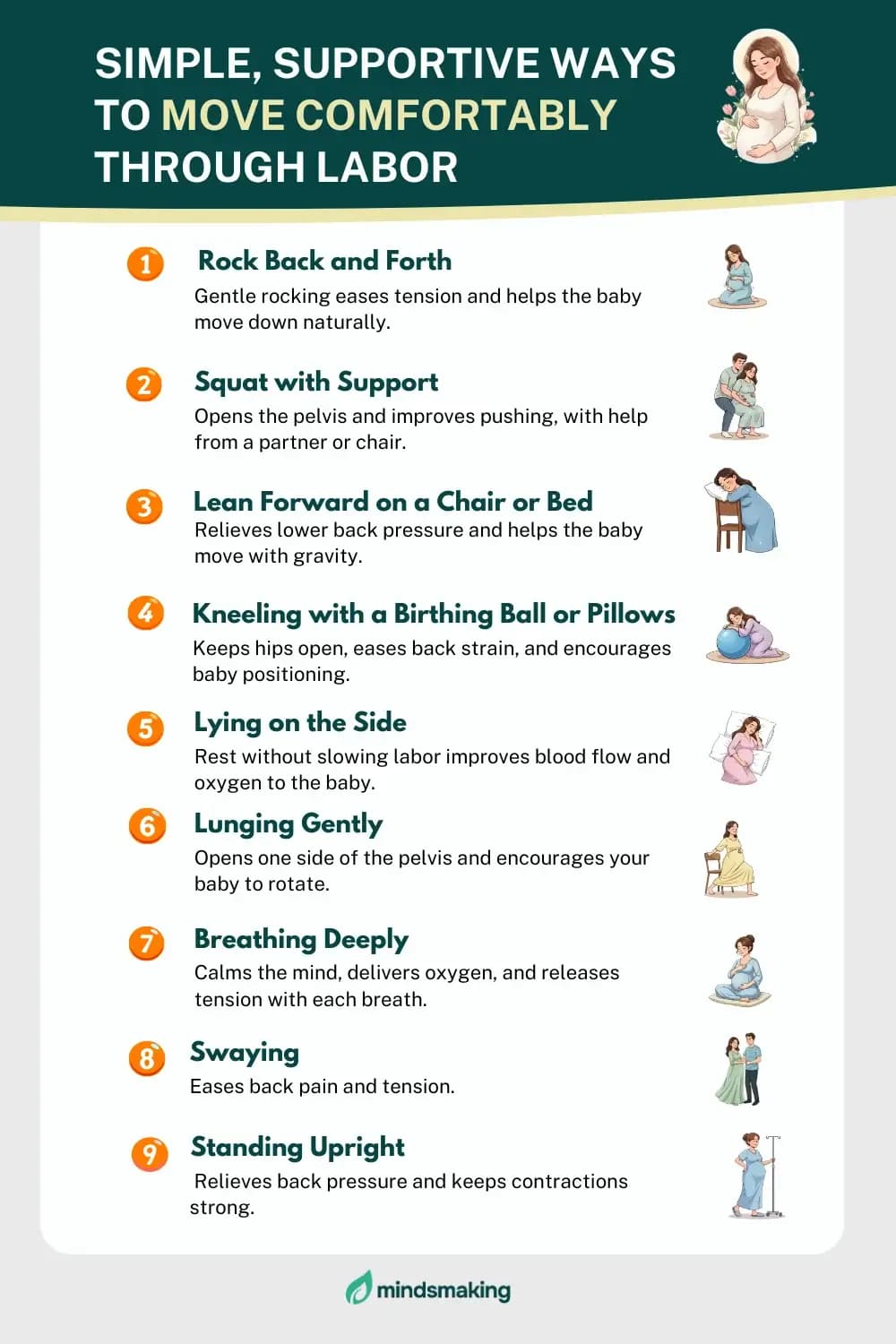
Rock Back and Forth
When contractions start rolling in, sometimes the simplest movements like rocking bring the most relief. The gentle back-and-forth motion helps ease tension, open your hips, and encourage your baby to move down naturally.
You can try rocking in different ways: sit on a birthing ball and roll your hips in slow circles, get on hands and knees and gently shift your weight back and forth, or lean into your partner’s arms while standing and swaying together. The motion keeps your pelvic joints flexible, improves blood flow, and helps your body stay relaxed rather than fight each contraction.
Quick tip: Breathe with your movement, inhale as you lean forward, and exhale as you rock back. You are rocking your way to motherhood.
Squat with support
If there’s one move that truly works with gravity, it’s the good old squat. With your partner, a sturdy chair, or a squat bar for support, this position can be a total game-changer. Squatting helps open your pelvis, giving your baby extra room to move down and helping you feel more in control of each push. It also helps increase pressure in the right direction, making contractions more effective and possibly shortening the pushing stage.
If you get tired (and you will!), rest between contractions by leaning back into your partner’s arms or holding onto something steady. What matters is balance and teamwork.
Quick tip: Keep your heels grounded and your jaw relaxed.
Lean forward on a chair or bed.
Sometimes, leaning forward is all it takes to turn chaos into calm. Resting your upper body on a chair, birth ball, or the edge of your bed helps relieve pressure from your lower back and gives your baby space to move into a better position. This position also uses gravity to your advantage, easing discomfort and helping contractions work more efficiently.
You can sway your hips gently, rest your head on folded arms, or have your partner massage your back while you breathe through each wave. It’s grounding and soothing, and gives your body a moment to regroup while still making steady progress.
Quick tip: Place a soft pillow under your knees for comfort. Your back and baby will both thank you!
Kneeling with a birthing ball or pillows
If your back is begging for mercy, kneeling can be a lifesaver. Rest your upper body on a birthing ball, a stack of pillows, or the edge of the bed to take pressure off your spine while letting gravity help your baby move down. This position keeps your hips open, encourages optimal baby positioning, and gives your back and shoulders some well-deserved relief.
You can gently rock your hips, breathe deeply, or let your partner rub your lower back between contractions. This position allows you to focus inward, be calm and steady, and stay in tune with your body’s rhythm.
Quick tip: Add a soft blanket under your knees for extra comfort.
Lying on the side
When you need a break (and trust me, you will), lying on your side is your go-to position for rest without losing progress. It’s gentle on your body, especially if you are tired, have back pain, or need to slow things down a bit. This position helps improve blood flow, reduce pressure on your lower back, and maintain steady oxygen flow to your baby. It’s also a great choice if you’ve had an epidural or just need a calm moment between contractions.
Place a pillow between your knees to open your hips and another under your belly for support. Your partner or nurse can help adjust your position for maximum comfort.
Quick tip: Switch sides often. This helps your baby rotate and keeps labor moving smoothly, even while you rest.
Lunging Gently
Lunging might sound like something from a workout routine, but during labor, it’s more about making room for your baby than breaking a sweat. A gentle lunge helps open one side of your pelvis, giving your baby room to adjust and rotate into the perfect position for birth. It’s especially useful if your baby needs a little encouragement to move down or turn.
You can do this by placing one foot on a low stool, step, or chair, keeping your other knee slightly bent for balance. Lean forward into the stretch during a contraction, then relax and breathe between them. Your partner or nurse can help you stay steady while you find your rhythm.
Quick tip: Keep your movements slow and relaxed. Each gentle lean brings your baby one step closer to your arms.
Breathing Deeply
It might sound simple, but during labor, your breath is your superpower. Deep breathing helps calm your mind, steady your heart, and remind your body that it knows exactly what to do. Each slow inhale brings oxygen to your baby, and each exhale releases tension, both physically and emotionally.
Try this when contraction begins: inhale slowly through your nose, filling your lungs and expanding your belly. Then exhale gently through your mouth, letting your shoulders drop and your body soften. Focus on the rhythm, not the pain. This helps you stay grounded and in control.
Quick tip: When in doubt, just breathe. Every deep, steady breath whispers, “I’m strong. I’m safe. I can do this.”
Swaying
Sometimes, the most natural thing your body wants to do during labor is sway, and that’s no coincidence. This position helps ease tension, soothe back pain, and encourage your baby to move down with the help of gravity. It’s almost like a slow dance between you and your baby, each movement bringing you closer to meeting face-to-face.
You can sway while standing and holding your partner, resting your arms around their neck, or while sitting on a birthing ball and moving your hips in small circles. The key is to stay loose and let your body lead.
Quick tip: Add soft music or dim lighting to make your swaying feel peaceful and grounding.
Standing Upright
When in doubt, stand tall. Standing upright during labor lets gravity work for you, guiding your baby downward with each contraction. It also helps relieve lower back pressure, improve circulation, and keep your contractions strong and effective. Plus, being on your feet gives you some sort of freedom. You can walk, sway, or lean into your partner for support as your body finds its natural rhythm.
Standing also helps you feel more in control and active in your birth experience. It makes you feel more involved in the process, moving with your baby every step of the way.
Quick tip: Try standing and leaning slightly forward during contractions. It takes pressure off your back and gives your baby the perfect path downward.
When to Ask for Help or Adjustment
Even the strongest mama needs a helping hand sometimes, because labor, while natural, is no small task. As your body shifts and your baby moves into position, your comfort level can change from one moment to the next. Knowing when to ask for support or a little adjustment is part of caring for yourself and your baby.
If you start to feel tired, dizzy, overheated, or uncomfortable, or if a position that once felt great suddenly becomes painful, speak up. Your midwife, nurse, or partner can help you change positions, add pillows or props for comfort, or bring in tools like a birthing ball or stool to ease pressure and help labor progress smoothly.
Also, don’t hesitate to ask for help if contractions slow or you feel lightheaded. Remember, asking for help isn’t a weakness. You’re listening to your body and doing what’s best for both you and your baby, and that’s exactly what strong mamas do.
Read This Next
No posts available
A Word From Mindsmaking
Everybody’s labor journey is unique, and patience matters. Your body knows what it’s doing, so trust the process and listen to your instincts. Every contraction, every shift, and every breath is bringing you closer to meeting your baby. You are doing great, stay flexible, stay supported, and remember that each step, no matter how small it feels, brings you closer to one of life’s most incredible moments.
Movement and comfort are your allies during labor. Changing positions, swaying, rocking, or leaning forward helps your baby move down, eases pain, and makes contractions more effective, while also keeping you calm, energized, and in control. Each stage of labor may call for different positions, so flexibility is key.
Above all, trust your body. It knows what to do, and your instincts will guide you through each contraction. Listen to yourself, breathe deeply, and don’t hesitate to ask for help or adjustments when you need them.
Pregnancy by Week
Welcome to the enchanting journey of motherhood, where every week unfolds a new chapter of anticipation, growth, and wonder.



























Was this article helpful?
How many stars are you giving this article?
Leave a comment
Your email address will not be published.