How Your Child Sees You at Every Age — From Baby to Teen
Aflo Images


Written by Mindsmaking Medical Writer

Fact Checked by Mindsmaking Professionals
2nd, February, 2026
As your child grows, so does their understanding, and their view of you will evolve with their age. Find out how your child sees you at every age, from baby to a teen, including what to do and what to avoid.
Every parent has wondered at least once or twice since becoming a parent, “How does my child actually see me?” Although it might not be in the literal sense, it could just be the way your children perceive you. Every developmental stage has unique ways in which children will perceive their caregivers. As your child grows, so does their understanding of you.
Their view of you will evolve with age from complete dependence in infancy to a hero in early childhood to critical thinking in adolescence. In this article, we’ll offer insights into how your child most likely sees you at every age, from a baby to a teen, and how these perceptions shape child development, parent-child relationship, and how you can respond thoughtfully through every season of parenting.
Key Takeaways
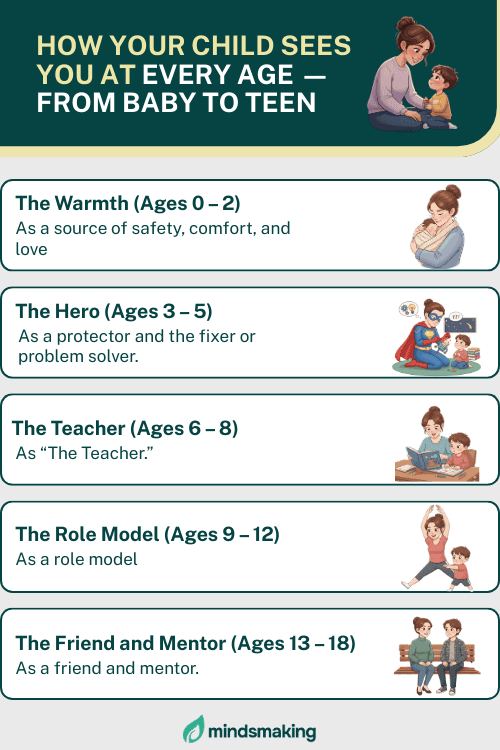
In the earliest stages of infancy and toddlerhood, from birth to 2 years, your little one views you as their safety and comfort and their entire world. In short, they trust you more than anything.
From age 3 to 5 years, during the toddler and preschool years, your child sees you as a hero, the protector, and the magical problem-solver who can fix anything.
Between the ages of 6 and 8 years old, your child sees you as their teacher, a guide and explainer of their never-ending questions.
As children enter the preteen years, from ages 9 to 12, they see you as a role model, and you become the standard against which they measure their behavior, choices, and values.
In the final stage of adolescence, from 13 to 19, your teenager will see you as a friend and mentor, not just a parent, but as a steady, trustworthy guide and friend.
The Warmth (Ages 0 - 2)
In this stage of infancy to early toddlerhood, from birth to two years, your child sees you as a source of safety, comfort, and love; the food, a weighted blanket, and safety all wrapped into one. To them, your presence is their entire universe. When they cry, they fully believe you are the one person capable of making life make sense again.
As babies observe the world, what they’re actually learning is trust. They watch your face, your reactions, and listen to your voice, trying to decode meaning. These early moments lay the foundation for emotional development, parent-child bonding, and lifelong attachment to parents. Even something as simple as how you smile back at them becomes a lesson in connection.
Keep showing up, respond to their cries, offer consistent comfort through touch, warmth, and your voice when you can. These small gestures are important for their social and emotional development. You don’t have to be perfect, just be present. Being their safe place is one of the most powerful roles you’ll ever play in their entire journey.
The Hero (Ages 3 - 5)
Welcome to the age where you officially become a caped hero to your child. Around the ages of 3 to 5 years old, your child sees you as a protector, the all-powerful fixer or problem solver, the bedtime-story voice actor, the banisher of monsters, the finder of their lost toys, and the sole person who knows how to make their food the “right way.” In their eyes, you’re strong, smart, and a hero.
As they grow, your toddler is watching you closely, learning and absorbing lessons about bravery, boundaries, confidence, and how to handle emotions. They’re learning from how you are not afraid to try new things, how you encourage them, and how you guide them through meltdowns and tantrums.
Now, as heroic as you may seem during this stage, there are a few behavioral pitfalls that can chip away all the efforts you're putting in. Yelling is one of them; it doesn’t just scare them, it shakes their sense of safety. Children feel safest with steady, soothing responses, and calm expressions of fear help maintain a predictable and secure world. Your reactions shape the lens through which they understand risk and reassurance.
Encourage independence but remain their safe anchor. So let them try to put on their shoes even if it takes a long time. Keep the parent-child bonding alive with hugs and set clear boundaries and predictable routines. They thrive on those.
The Teacher (Ages 6 - 8)
From the ages of 6 to 8 years of age, your child will enter the stage of big questions, so many endless questions. At this developmental stage, your child sees you as “The Teacher.” Not the kind with a chalkboard and a stern look, more like a life instructor they rely on for everything, like explaining rules, solving problems, and helping them understand the world they live in.
To your child, you are the ultimate guide to how the world works. They’re learning responsibility when you ask them to tidy up their toys or their room, fairness when you explain why hitting isn’t okay, and emotional regulation when you show them how to handle frustration. Your voice becomes a source of logic and reassurance, and whether you realize it or not, you’re building their understanding of cause and effect, empathy, and honesty.
Of course, with this new role, there are still some things you should avoid. Ignoring their endless questions may seem tempting, but to them, your silence is hurtful and a sign of rejection. So, avoid ignoring their questions and don’t be overly critical, as this can make them second-guess themselves.
And the biggest mistake is not modeling the very behavior you want from them. Kids in this age group have a radar for hypocrisy, and it's so sharp they could probably detect it from a mile away. They’re watching how you manage frustration, how you talk to others, and how you solve problems, and absorbing all of it. If you don’t model what you expect, you won’t see that behavior in them.
A good tip is to keep the conversation flowing when they ask questions by asking them what they think before answering. Model the very behaviour you want them to emulate, and the more you teach through daily interactions, the more grounded, thoughtful, and emotionally aware they’ll become.
The Role Model (Ages 9 - 12)
Welcome to the preteen years. In this chapter, your child sees you as a role model. Everything you do becomes a clue about how to behave, how to treat people, and how to handle life. You literally become a benchmark for behavior, morals, and handling challenges.
To your 9 to 12-year-old, you are the walking, breathing, and talking definition of what “good” looks like. They’re observing how you respond when plans go sideways, when someone upsets you, or when life throws the kind of curveball. This is also the phase when your child is learning integrity from how you keep your promises, resilience from how you bounce back, and self-discipline from how you manage work and family.
If you’ve been a good role model, you would see the results in your child. Whether you realize it or not, you are shaping their inner compass and their expectations of how humans should treat one another.
However, at this stage, you should avoid being controlling and dismissing their growing independence. They’re craving small freedoms, and when you shut those down, it strains your relationship. Also, kids at this age have ZERO tolerance for the “Do as I say, not as I do” approach. If you preach kindness and then speak rudely or aggressively at someone in traffic, they notice. If you tell them to stay off devices but scroll through your’s during dinner, they notice.
Lead by example, even when it’s inconvenient. When you embody the values you hope they carry, you strengthen the parent perception they’ll hold onto for life. You’re not just teaching them how to live, you’re showing them, and that leaves a mark deeper than any lecture ever could. So, let them see you take responsibility, apologize when needed, and encourage their independence by allowing them to make safe choices or learn from small mistakes.
Read This Next
No posts available
The Friend and Mentor (Ages 13 - 18)
Ah, the teenage years. The era of closed bedroom doors, eye rolls, and heartfelt late-night conversations that sometimes happen randomly. In this final chapter, your child sees you more like a friend and a mentor, more like the steady, trusted adult who doesn’t freak out when they talk about a mistake they made.
Through the lens of a teenager, you're no longer just the rule-maker; you’re the safe place they circle back to when the world feels heavy, confusing, or unfair. Teens go through explosive emotional development, shifting identities, new friendships, and growing independence. Through it all, they view you as someone who teaches them whether it’s safe to open up. They are constantly learning communication, trust, emotional intelligence, and decision-making from observing you.
However, this stage also comes with mistakes you should avoid making. You should not overreact to their mistakes, micromanage or interrogate them, or withdraw from them emotionally. Teenagers are hypersensitive to these kinds of shifts as they’re old enough to read tone, subtext, and your stressed-out sigh. Your influence remains powerful, just quieter.
Listen to them more than you lecture and ask them questions that don’t feel like an investigation. Respect their privacy by knocking before entering their space, not commenting condescendingly on every outfit, and not turning their teenage antics into a family group-chat joke. Be the calm they can return to, the voice that doesn’t judge, and the presence that reminds them that they’re loved at home.
A Word From Mindsmaking
Parenting isn’t about perfection but about presence. So, embrace how your child sees you at whatever age they are, be it from baby to teen. Every stage offers a unique opportunity to connect, guide, and grow alongside your child.
So take a deep breath, laugh at the messes, and relish the moments. Watching your child see you differently at each stage is a reminder that your presence and patience are the true superpowers that shape their worldview.
Was this article helpful?
How many stars are you giving this article?
Leave a comment
Your email address will not be published.