How to Save a Choking Child: Step-by-Step First Aid Guide
Getty Images


Written by Mindsmaking Medical Writer

Fact Checked by Mindsmaking Professionals
2nd, December, 2025
Every 5 days, a child dies from a choking incident in the United States alone, and when parents know the steps to save a choking child, the outcomes are better. Find out the steps to save a choking child.
A choking emergency is every parent’s worst nightmare; however, knowing exactly what to do and staying calm matters, as it can turn a panic-filled situation into lifesaving action. Research shows that every 5 days, a child dies from a choking incident in the United States alone [5]. This makes it even more important to stay prepared, recognize the signs of choking early, and act quickly with the right first aid steps. Studies reveal that when parents or caregivers knew what to do, outcomes were far better than when they didn’t preparation truly saves lives.
Key Takeaways
Gagging is a natural reflex to prevent choking when swallowing food and is noisy as it involves loud coughing. But with choking, it’s silent as there is a complete obstruction of the airway by either food or any object, and air can't pass through.
If a child is choking, stay calm and act fast. Give 5 back blows followed by 5 abdominal thrusts (chest thrusts for infants). Repeat until the object clears or help arrives. Call emergency services immediately if the child can’t breathe or speak.
Always remain calm during a choking emergency, as panicking makes the brain less able to plan, prioritize, and perform the needed first aid actions that can save a choking child in emergencies.
Avoid these mistakes when a child is choking: don’t stick fingers in their mouth, shake, or hang them upside down. Don’t give food or drink.
How to Tell If a Child Is Choking
Sometimes, a child may not be choking. It could be that they are gagging on food they find difficult to manage. Knowing the difference between gagging and choking is important, as it can prevent a gagging incident from turning into a choking emergency.
Gagging is a natural reflex in humans to prevent choking when trying to swallow food. It is usually noisy with lots of coughing, spit-ups, and sticking out the tongue. But with choking, there is a complete obstruction of the airway by either food or any object, and air can't pass through.
This becomes an emergency because the brain cannot go without oxygen for an amount of time. Signs of choking include the inability to cough, high-pitched squeaking or no sound, pale or bluish skin, inability to cry or speak, panicked expression, and loss of consciousness [2].
During mealtimes, stay calm and observant. Gagging is often normal and part of learning to eat, so let your child manage it and encourage gentle coughing. But if a child can’t breathe, cry, or make a sound, it’s likely choking act fast and perform first aid, or the Heimlich manoeuvre, immediately.
What are The Steps to Take to Save a Choking Child?
When signs of choking have been noticed, it's a race against time to get the blockage out of the child's airway, as it can lead to loss of consciousness from lack of oxygen and possible death due to Asphyxiation.
The American Red Cross gives a consistent first-aid protocol during a choking emergency. Here are the steps to take to save a choking child [1]:
For a Conscious Infant (under 1 year):
- Call emergency services for help, or ask someone to call.
- Place the infant face down on your forearm with the head lower than the bottom, and support the head and jaw with the same hand.
- Give 5 firm back blows between the shoulder blades with the heel of your hand.
- If not cleared, turn the infant face-up while supporting the head with the same hand, and give 5 chest thrusts with two fingers in the center of the chest just below the nipple line (compress just 1.5 inches deep).
- Alternate between 5 back blows and 5 chest thrusts until the object clears, emergency responders arrive, or the child becomes unresponsive.
For a Conscious Child (older than 1 year):
- Call emergency services for help, or ask someone to call.
- Stand or kneel behind the child, bend them forward at the waist, and deliver 5 firm back blows between the shoulder blades with the heel of your hand.
- Still standing behind, place a fist (thumb in) just above the navel, cover with the other hand, and give 5 quick upward and inward chest thrusts.
- Alternate between 5 back blows and 5 abdominal thrusts until the object is expelled, the child coughs/ breathes/ can cry, emergency responders arrive, or the child becomes unconscious.
For an Unconscious Child or Infant:
- Place the child flat on the ground and kneel beside them.
- Begin CPR immediately with 30 chest compressions for both infants and children (fingers 1½ inches in for infants and both palms over the chest, pressing 2 inches in for children)
- Give 2 rescue breaths for both infants and children.
- Look for the object in the mouth, and if you can see it, swipe it out; but if you can't, don't swipe and repeat with 30 chest compressions.
- Alternate between compressions and deep breaths until the object is dislodged, the child is conscious, or until help arrives.
Why Staying Calm and Prepared Can Help Save a Choking Child
Research shows that the brain’s stress hormones, adrenaline and cortisol, are designed to protect us, but when they run too hot, decision-making and fine motor control could be hindered [4]. The review explains that prolonged or extreme stress alters the brain’s circuits and hormone responses, making thoughtful, coordinated action harder to achieve. In other words, if a parent or caregiver is panicking and overwhelmed during a choking emergency, their brain is less able to plan, prioritize, and perform the needed first aid actions that can save a choking child in emergencies.
This can look like rapid, panicked reactions such as screaming, freezing, and fumbling, and this can delay the one or two precise maneuvers like back blows and chest or abdominal thrusts needed to clear the airway. Remaining calm helps one remember the steps and apply them correctly.
If you ever face a choking emergency, take a moment to stay calm. Inhale deeply for 3–4 seconds and exhale for 4–6 seconds. This simple belly-breathing technique helps lower panic, clear your mind, and lets you act quickly and effectively.
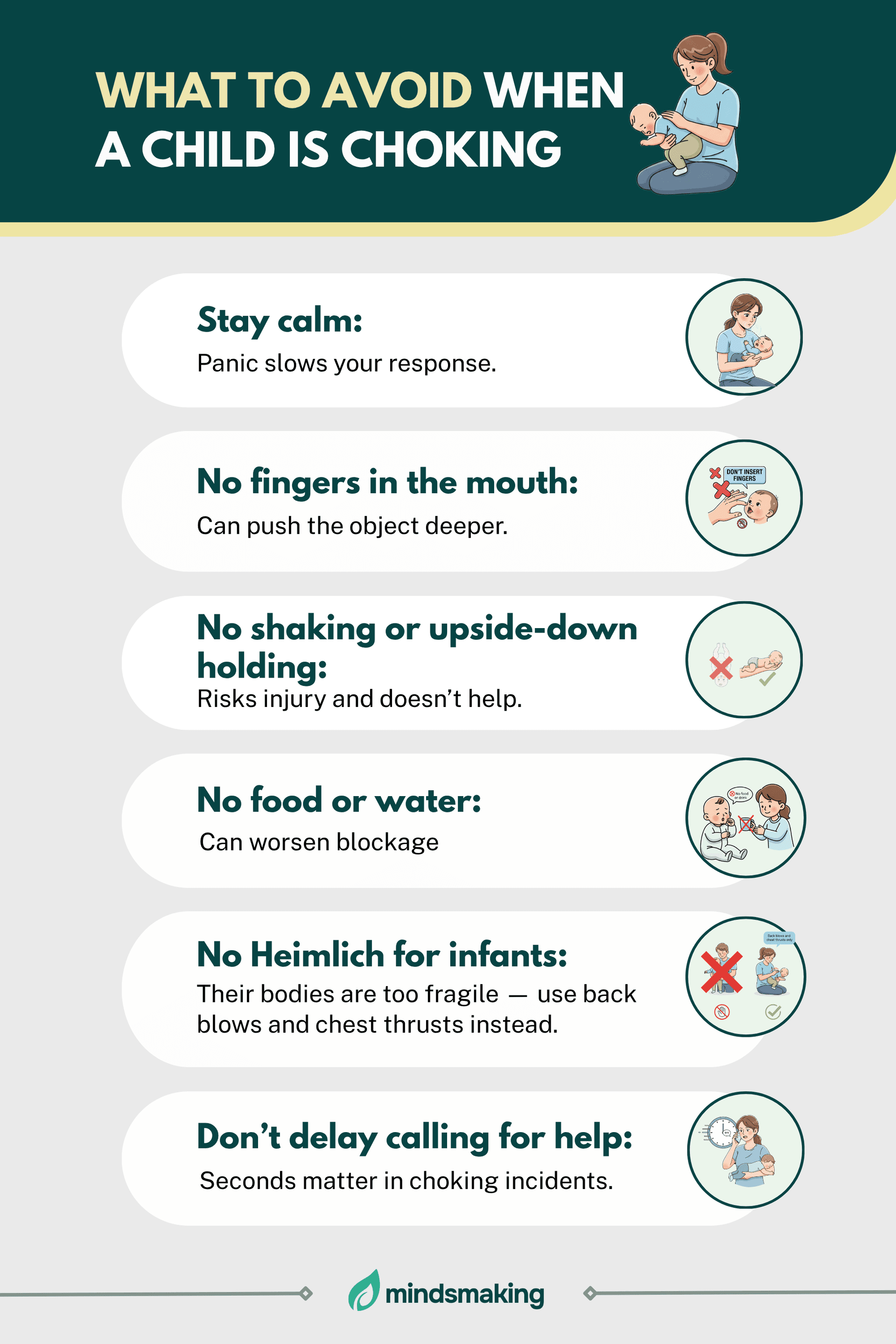
What to Avoid When a Child is Choking
These mistakes can make things worse:
- Don’t stick your fingers in their mouth unless you can clearly see and easily remove the object, you might push it deeper.
- Don’t shake, slap, or hang the child upside down this doesn’t help and can cause injury.
- Don’t give them food or drink, liquids can block the airway further.
- Don’t perform the Heimlich maneuver on infants (under 1 year) their bodies are too delicate use back blows and chest thrusts instead.
- Don’t delay calling emergency services if the child can’t breathe, cough, or make any sound get help immediately.
- Don’t panic staying calm helps you act quickly and effectively.
Read This Next
No posts available
A Word from Mindsmaking
Knowing the steps to take to save a choking child is about more than memorizing maneuvers and CPR; it’s about preparing the mind so one can act quickly and effectively under pressure. Calmer parents and caregivers in the face of emergencies make better decisions. With a little preparation and consistent safety habits, you’ll be ready to protect your child when it matters most.
Please note that this article is based on current research. However, it is essential to consult your healthcare provider for personalized medical advice tailored to your unique situation.
Was this article helpful?
How many stars are you giving this article?
Leave a comment
Your email address will not be published.