What a 1-Month-Old Can Do and Can't Do

Written by Mindsmaking Medical Writer

Fact Checked by Mindsmaking Professionals
15th, December, 2025
It is normal to expect a lot from your baby in the first month after 9 months of pregnancy. However, there is a clear list of what your 1-month-old can do and cannot do at this stage.
Finally, your tiny baby is now 1-month-old, and this is a wonderful time to notice what your 1-month-old can do and can’t do. This period is often filled with rapid adaptation and tender connection for you and your child. Your newborn is adjusting to life outside the womb, learning to eat, sleep, and find comfort in your presence. This stage of early infancy may seem slow and unpredictable, but every cuddle, stretch, and soft cry represents meaningful progress in your 1-month-old baby’s development, even if this means waking up in the middle of the night.
It is important to remember that every baby develops differently. Some may start responding to your voice or maintaining brief eye contact earlier, while others take a little more time. Each baby is unique, and so is their pace of growth. Therefore, these differences are completely normal. As far as your baby is showing gradual signs of progress, there is no cause for concern.
Definitely, what your baby can do now is limited, but exciting progress is on the way.
Key Takeaways
At 1 month, your baby can reflexively root, suck, and grasp, make small movements, focus on faces, respond to familiar voices, communicate needs through cries, and find comfort in your touch and voice.
By 1 month, your baby still needs full head support, cannot reach or grasp intentionally, has a short visual range, sleeps irregularly, and only shows reflex smiles, all of which are normal steps in early development.
You can support your 1-month-old’s growth through gentle, loving interactions like tummy time, talking and singing, skin-to-skin contact, responsive care, and high-contrast visuals, which build the foundation for healthy development.
Contact your pediatrician if your 1-month-old shows no startle response, feels unusually floppy or stiff, has very limited movement or little eye contact, struggles with feeding or weight gain, or is unusually lethargic.
What a 1-Month-Old Baby Can Do
Your 1-month-old may be small, but they are already showing signs of healthy baby development. Growth at this stage happens quietly and in the most heartwarming ways. You can tell this with how your baby moves, responds, and starts noticing the world. Here is what your baby can do at 1 month:
What a 1-Month-Old Baby Can Do

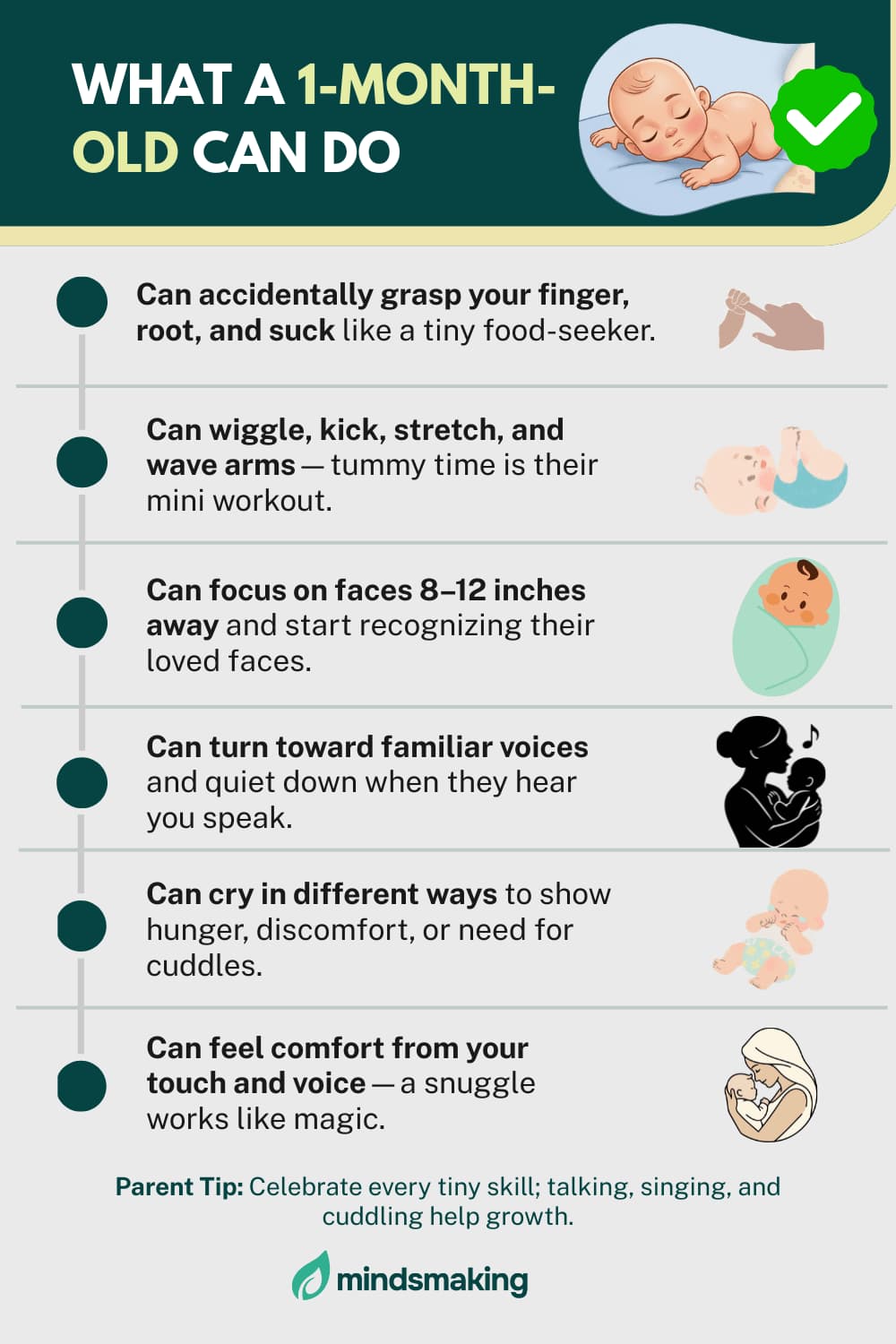
Can accidentally grab your fingers
Your baby might grab your finger like they’re making a lifelong pact. It’s adorable and slightly shocking how strong that tiny grip is. But don’t be fooled, they’re not trying to keep you forever (not yet anyway). It’s just a natural reflex called the grasp reflex. Still, it’s your baby’s early way of saying, “Hey, you feel familiar… I like that.”

Can turn toward your touch
Stroke your baby’s cheek and watch them turn their head like a little food detective on a mission. This is called rooting, and it’s how they track down milk, even if they just finished eating ten minutes ago. Their instincts are strong, and apparently, their appetite is too. It’s basically built-in GPS for snack time.

Can start sucking naturally
When something touches the roof of your baby’s mouth, they’ll start sucking right away. No instruction manual required. This reflex helps them feed and shows off their impressive natural skill for finding food. If only adults could learn that fast imagine what we’d get done if snacks were our superpower.

Can move arms and legs a lot
Your baby’s wild kicks and arm flails might look random, but there’s a real purpose behind them. Every wave, stretch, and tiny karate move is helping them build strength and coordination. During tummy time, they might even lift their head for a second before face-planting with pride. It’s all part of the baby workout routine. Gains are coming.

Can only see your face when close
Your baby can only see about 8 to 12 inches away, which is just enough to admire your face when you hold them. So yes, you are literally their favorite thing to look at. You might be sleep-deprived and running on cold coffee, but to your baby, you’re pure art. Picasso who?

Can turn toward noises or sounds
A loud noise might make them jump, but your voice? That’s their safe place. They’ll turn toward it like, “Oh, it’s you. Good.” They’re already learning the difference between random background chaos and the voice they trust most. You’re basically the main character in their world right now. Enjoy the fame while it lasts.

Can communicate through cries
Right now, crying is your baby’s all-in-one messaging system. Hungry? Cry. Tired? Cry. Slightly offended by a wrinkly sock? Definitely cry. But soon, you’ll start noticing subtle differences: the “feed me” cry, the “I’m bored” cry, and the “I just need to be held because I’m cute” cry. You’ll become a baby-whisperer before you know it.

Can feel comfort through your touch and voice
When you cuddle or talk softly, your baby instantly relaxes. Your arms are their favorite place, your voice their favorite sound. It’s like baby magic; stress melts away, tiny eyelids droop, and peace is restored. These moments are how they learn that the world is safe and full of love. And honestly, they remind you that sometimes, love really is that simple. It is important to reassure your baby at this stage so they can feel safer in this new world. Even the smallest responses, like a soft coo or a steady gaze, matter. The way your baby quiets when you speak is a sign of gentle but meaningful progress in their development. Growth right now may seem small, but it is unfolding beautifully with each passing day.
What a 1-Month-Old Baby Can't Do Yet
Your baby is already a tiny miracle with some impressive reflexes, but let’s be honest, there’s still a lot they can’t do yet. And that’s okay! This is the chill stage of babyhood, where most skills are still buffering. So take a deep breath, grab a coffee (or two), and enjoy watching your little human figure life out one wiggle at a time.
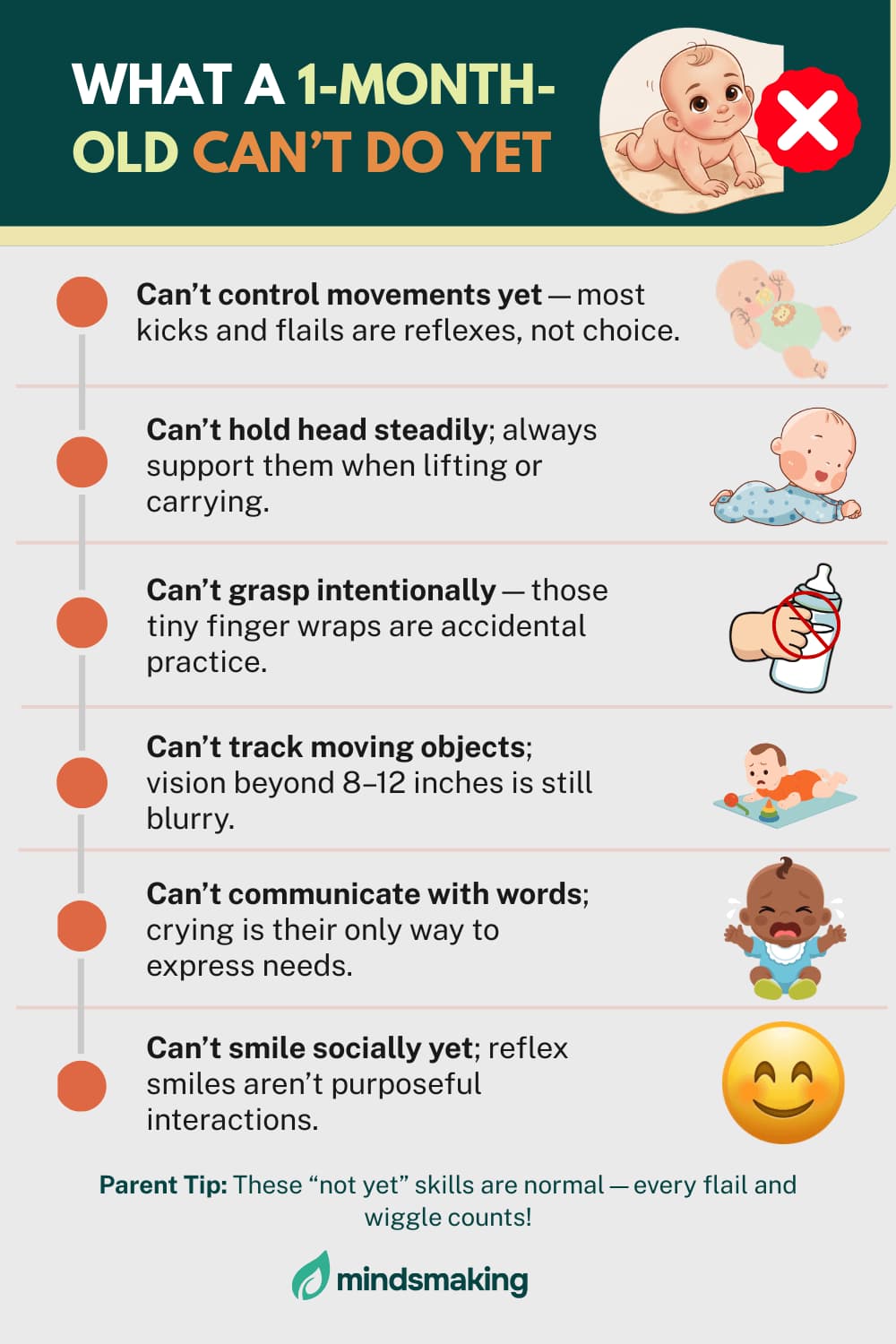
Can’t hold their head up alone: Your baby’s neck muscles are still working their way up from noodle status. So no, they can’t hold their head up yet, at least not for more than a heroic second or two during tummy time. Always support that wobbly little head; it’s basically their most dramatic feature right now. Think of this stage as “neck day training,” and you’re their personal gym spotter.
Can’t control their hands well: Those flailing arms and random swats? Totally normal. Your baby’s hands currently have zero coordination and 100 percent enthusiasm. They’re not grabbing things on purpose; they’re just accidentally landing hits on your face or pulling their own hair. Don’t worry, every awkward flail is just baby practice for future high-fives.
Can’t feed on their own yet: they depend entirely on their built-in instincts, like rooting and sucking reflexes, to find and take in milk. When they turn their head toward your touch or start sucking the moment something brushes their lips, that’s nature doing its job. They’re not quite ready to hold a bottle or breastfeed solo (nice try, though), but these reflexes are their way of saying, “Don’t worry, I’ve got the basics covered you just keep the milk coming.”
Can’t see far or track moving objects: Right now, your baby’s vision is about as clear as someone trying to see through a foggy bathroom mirror. They can only focus on things 8 to 12 inches away; conveniently, that’s the distance to your face when you’re holding them. Anything farther than that is just background blur. But your face? That’s the VIP channel they never get tired of watching.
Can’t sleep through the night: Sleep through the night? Absolutely not. Your baby’s internal clock runs on “feed me” and “hold me” time zones. They’ll wake up every few hours just to make sure you’re still around (and maybe to remind you who’s in charge now). This is normal. Coffee helps. So does reminding yourself that one day you will sleep again, probably.
Can’t give real smiles yet, only reflex ones: Those sweet little smiles you’ve been obsessing over? Sorry to break it to you, they’re still just reflexes at this point. Your baby’s face is basically doing random test runs of future emotions. The real smiles, the ones that melt your soul, usually show up around six to eight weeks. Until then, enjoy the practice versions; they’re still ridiculously cute.
Every “can’t yet” moment is secretly a “coming soon” moment. Your baby is learning, stretching, and growing faster than it seems, even when they look like they’re just staring into space. So don’t rush it these slow, sleepy weeks are part of the magic.
How to Support Your 1-Month-Old’s Growth and Development
Even at just one month old, your baby can learn from the world around them. You do not need elaborate schedules or complicated routines. Just your gentle and loving interactions matter far more than structured practice. Here are some simple ways you can nurture your baby’s development at this stage.
Tummy Time: Giving your baby a few minutes of tummy time two to three times a day helps strengthen their neck and shoulder muscles. At first, your baby may fuss or lift their head only briefly, but those small efforts are building the foundation for head control, rolling, and crawling later. Even a minute or two of supervised tummy time while you smile and talk to them counts as a big win. However, ensure to keep the session brief at this stage.
Talking and Singing: Talking and singing to your baby builds early language pathways and strengthens the bond between you both. Narrate what you are doing, hum a favorite tune, or simply tell them about your day. Your baby may not understand the words yet, but they can feel your warmth and attention. You might even get a tiny coo or wide-eyed stare in return.
Skin-to-Skin Contact: Holding your baby against your chest for skin-to-skin contact helps regulate their breathing and body temperature while still improving the bond. It is incredibly soothing for your baby and a wonderful way for you to feel their small heartbeat and sense of trust developing. Those quiet snuggles are more powerful than any formal training session.
Responsive Care: When your baby cries, it is important to comfort them immediately. This responsive care makes them feel safe and secure. You can pick them up, hold them gently, and speak softly. This is a way of teaching your baby that the world can be caring and predictable while also supporting their social and emotional growth.
High-Contrast Visuals: Babies are fascinated by bold patterns and contrasts. Introducing high-contrast visuals like simple black-and-white toys, picture cards, or patterns on a blanket helps stimulate your baby’s visual development. Even letting your baby glance at a high-contrast image during tummy time or while cuddled on your chest can engage their focus and curiosity.
By focusing on these small but consistent interactions, you are doing so much for your baby’s growth. Your love, attention, and presence are shaping your baby’s development far more than any structured schedule could. The gentle ways you engage with your 1-month-old today are the building blocks for all the incredible skills they will develop in the weeks and months to come.
Read This Next
No posts available
When to Call the Pediatrician
Most 1-month-old babies grow and develop wonderfully with your love and care, but it is helpful to know a few signs that may require extra attention. You do not need to worry about every little quirk, but if you notice any of the following, it is best to reach out to your pediatrician.
No startle response to loud sounds: If your baby does not blink, jerk, or show any reaction to sudden noises, it could indicate a hearing or neurological concern.
Baby feels unusually floppy or stiff: Your baby should feel soft but responsive in your arms. Extreme limpness or unusual rigidity is worth checking.
Very limited movement or little eye contact: If your baby seems unusually still, does not move arms or legs much, or rarely looks at your face, it may be a sign to discuss with your doctor.
Poor feeding or no weight gain: If your baby struggles to feed or is not gaining weight as expected, it is best to see your pediatrician.
Trouble waking for feeds or persistent lethargy: Babies should be alert enough to wake for regular feedings. Unusual sleepiness or difficulty with waking your baby may warrant a medical check.
A Word From Mindsmaking
These first weeks with your 1-month-old may not be as easy as you imagined because of sleepless nights, frequent feedings, and the constant demands of new parenthood. However, each small sound, stretch, and gaze from your baby builds connection and shows that their development is gentle and ongoing.
Take time to notice and celebrate the little wins. When your baby looks at you with wide eyes, gives a tiny coo, or stretches their little arms toward you, these moments are meaningful signs of growth and bonding. Every action, no matter how small, helps your baby learn about the world and feel safe with you.
Finally, there is no rush; your baby is growing beautifully, learning, and discovering at their own perfect pace. Enjoy these early weeks and trust that each day brings new steps in their development.
Was this article helpful?
How many stars are you giving this article?
Leave a comment
Your email address will not be published.