20-Month-Old Toddler Development and What to Expect

Written by Mindsmaking Medical Writer

Fact Checked by Mindsmaking Professionals
4th, November, 2025
At 20 months, your toddler is full of energy, exploring, learning new words, showing emotions, and growing independence, yet there is much more to know about their development.
Life with a 20-month-old is full of excitement, surprises, and a fair share of adorable chaos. You have already seen how much your little one has grown from birth, and now each day brings new opportunities to cheer, guide, and occasionally catch before they tumble. It is all about celebrating progress while supporting your toddler as they discover what they can do.
At this age, your toddler is bursting with energy, curiosity, and big emotions. They are exploring everything in sight, reacting with laughter, delight, or dramatic frustration when things do not go as they want. You might also catch them running, climbing, and investigating every corner of their world like a tiny boss. Of course, you will be entertained, exhausted, and amazed all at once as they experience this whirlwind of growth.
No doubt, your baby is becoming more independent by the day. They are learning new words, naming objects, and showing clear preferences for toys, snacks, and activities.
Key Takeaways
At 20 months, your toddler is rapidly developing physical and motor skills, becoming more coordinated, confident, and independent while exploring, playing, and practicing self-feeding and dressing every day.At 20 months, your toddler is rapidly developing physical and motor skills, becoming more coordinated, confident, and independent while exploring, playing, and practicing self-feeding and dressing every day.
Your 20-month-old toddler is expanding their vocabulary, combining simple words, following basic instructions, and recognizing familiar people and objects, while enjoying songs and books that improve language and memory.
Your 20-month-old is learning to solve problems, recognize people and routines, imitate adults, and enjoy simple games, all of which support cognitive growth, memory, and emotional development.
At 20 months, toddlers are learning to balance independence and attachment, manage big emotions, and explore parallel play, all of which support social skills, emotional development, and early friendship building.
By 20 months, toddlers are learning to balance independence and attachment, manage big emotions, and explore parallel play, all of which support social skills, emotional development, and early friendship building.
Your toddlers at 20 months need 11 to 14 hours of sleep, including a daytime nap, to support growth, learning, and emotional development, though common challenges like resisting naps and nighttime wake-ups may occur.
Your toddler may become picky eaters at 20 months, so offering a variety of healthy finger foods, encouraging self-feeding, continuing milk, and avoiding choking hazards is essential for safe nutrition and growth.
Engaging your 20-month-old in activities like outdoor play, reading, offering safe choices, and limiting screen time supports motor skills, language, independence, and emotional development.
Watch for signs like not walking, not using words or gestures, not responding to their name, losing skills, or avoiding eye contact, and consult a pediatrician promptly.
Physical and Motor Development
By 20 months, your toddler is becoming more coordinated, confident, and eager to show off their growing physical skills. To your baby, each day is like a mini adventure as they walk, climb, and dance their way through the house with unstoppable energy. You will notice they want to do almost everything by themselves now, from feeding to dressing, and they do it with so much determination that you cannot help but cheer them on.
Physical and Motor Development

Walking confidently and running
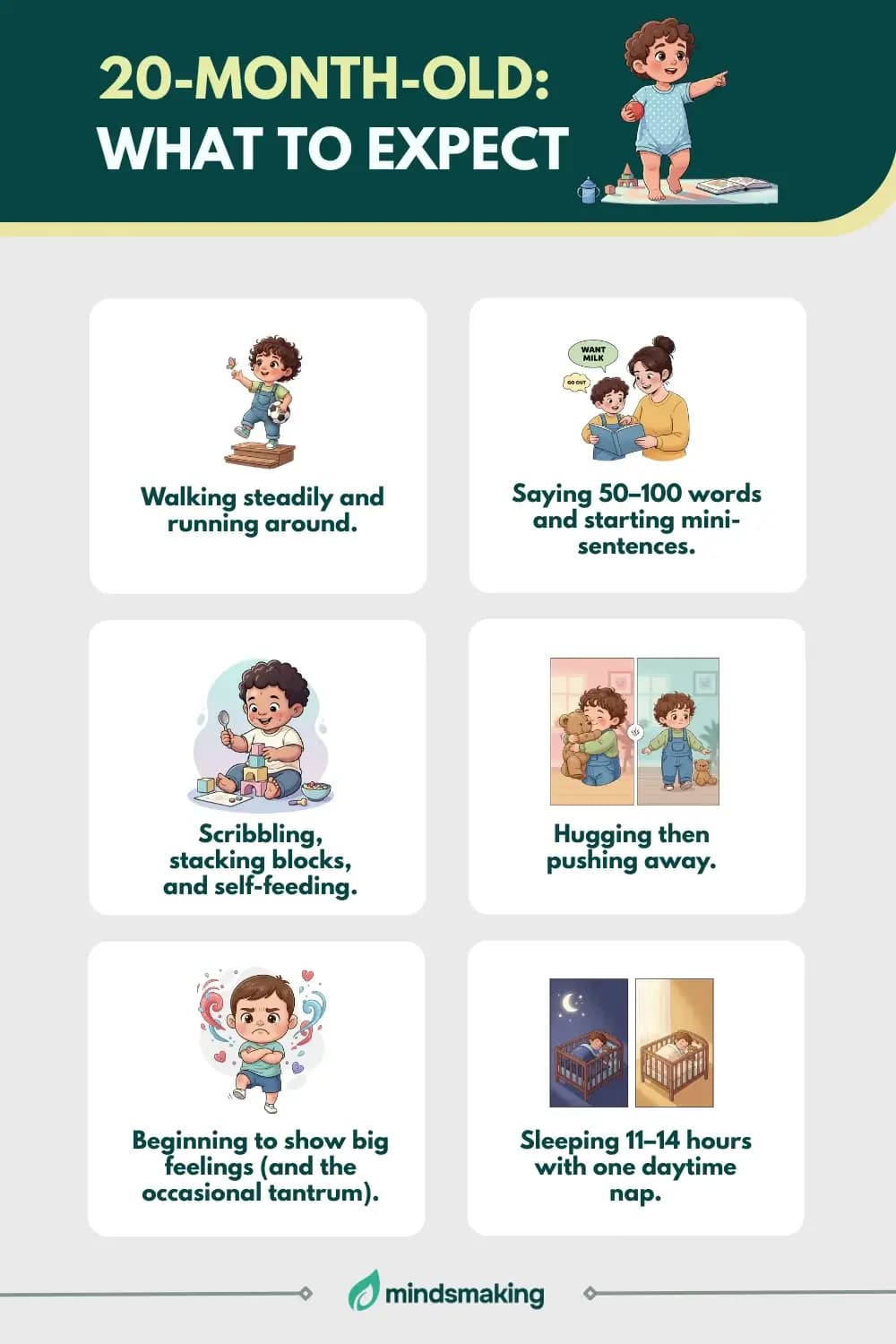
Your little one now walks like they have mastered it, even if their balance still needs a little work. Some toddlers may still work a bit unsteadily and that is completely normal. One moment they are walking proudly across the room, and the next, they are running off with your slippers. It is both exciting and a little exhausting keeping up with those quick little legs.

Climbing furniture and stairs with support
You may remember during the 18-month-old toddler development stage when your baby was just beginning to test their balance and independence. Now, at 20 months, sofas and low steps are becoming irresistible challenges. You will catch them hauling themselves up the couch or testing the first step, and you will be right behind them to offer a steady hand and an impressed cheer.

Beginning to kick or throw a ball
Simple ball play is suddenly a highlight for you and your baby. They may kick the ball sideways or fling it with surprising force, but the grin when it moves is pure joy. Rolling a ball back and forth becomes an instant game you both love at this stage.

Dancing or moving to music
Turn on music and watch them move their little body. They may bounce, spin a little, or give an enthusiastic arm wave. Their rhythm might be unique, but it is infectious, and you will probably find yourself joining in more than once.

Using hands with better control
Your baby's fine motor skills are improving fast. They stack blocks, turn pages, and manipulate toys with growing intent. Those concentration faces are priceless, even if the block tower does not last long.

Scribbling with crayons or markers
Give your toddler a crayon and see how their creativity follows. Their marks are the beginning of drawing and hand-eye coordination. Expect colorful masterpieces on paper and, occasionally, on surfaces you did not expect.

Self-feeding with spoon and fork
Mealtimes have become your baby's way of practicing independence. They scoop, dip, and sometimes miss, but each attempt builds coordination. Celebrate the successful spoonfuls and accept the occasional peas on the floor as part of learning and growth behavior.

Attempting to undress or help with clothing
Dressing time has now become a teamwork exercise between you and your baby. In short, your baby is mostly in control, except you want them to let out a cry that says, “I am in charge now.” They try to pull off socks or push arms through sleeves, which can be hilariously slow and deeply satisfying for them. When you allow them, it helps build confidence and make routines more playful.
Language and Communication Development
There is nothing quite like hearing your little one’s voice come to life. Sometimes it is just adorable babbles, and other times it is clear words that stop you in your tracks. During this stage, your baby is discovering how to express themselves through sound, gestures, words, and emotions. Here is what to expect:
Expanding vocabulary (50 to 100 words): By now, your toddler’s vocabulary may range from around 50 to 100 words, though some may have more or fewer, and that is perfectly fine. You might hear familiar favorites like “mama,” “dada,” “ball,” or “bye-bye.” Some days they seem to repeat one word all day long, while other times they surprise you with a brand-new one. It is all part of their growing toddler speech development.
Combining two words: You may start hearing adorable mini-sentences like “More milk,” “Mama come,” or “Daddy go.” These short phrases mark an exciting milestone in toddler speech. It is their way of putting thoughts together and learning how words connect. Every small phrase deserves a big cheer because it is your child’s first step toward conversation.
Understanding simple instructions: Your baby is also learning to understand much more than they can say. Simple directions like “Bring your shoes” or “Sit down” may now earn a proud response, though they might also choose to ignore it when they are busy exploring. This growing comprehension shows how quickly their brain connects words to actions.
Enjoying songs, rhymes, and naming things in books: Nothing lights up a toddler’s face like music and storytime. They may clap to a rhythm, hum along to nursery rhymes, or eagerly point to pictures in their favorite book. Reading together and singing often help improve both vocabulary and memory. It is also a wonderful way to bond and laugh together.
Cognitive Development
Your 20-month-old’s little brain is always busy, soaking in every sight, sound, and movement around them. You can almost see their curiosity in action as they explore, test boundaries, and copy everything you do. Whether they are trying to open a cupboard you just closed or figuring out where their toy disappeared, they are constantly learning how the world works. It is both fascinating and funny, especially when their solutions make more mess than progress. Here is how your baby's brain is developing:
Solving simple problems: Your toddler is now becoming a tiny problem solver. When their ball rolls under the chair, they bend, peek, and try to reach it instead of calling for help right away. Sometimes they succeed, and other times they give you that priceless “uh-oh” look for backup. Either way, it shows how quickly they are learning to think, plan, and figure things out on their own.
Recognizing familiar people, objects, and routines: Your toddler’s memory is getting stronger every day. They know exactly which cup is theirs, recognize their favorite teddy from across the room, and squeal with joy when a familiar face walks in. Even daily routines like bath time or bedtime now make perfect sense to them, though skipping one might lead to a mini protest that could rival an award-winning performance. These are beautiful signs of baby development and emotional awareness.
Imitating adult behavior: This is the stage where you get your very own mini version of yourself. They hold your phone to their ear and say “hello,” push a broom around the room like a pro, or try to feed their stuffed animals just like you feed them. It is heart-melting and hilarious at the same time, proof that they are watching, learning, and doing their best to be just like you. Their behavior mirrors what they see, showing how quickly they absorb and imitate adult actions as part of their emotional development.
Simple games and puzzles to support learning: Now is the perfect time for simple games that make learning fun. They might try to fit shapes into holes, stack blocks, or play peekaboo with endless excitement. Each attempt, no matter how messy, builds focus, memory, and problem-solving skills. Honestly, those giggles when they finally get it right are worth every scattered toy on the floor.
Read This Next
No posts available
Social and Emotional Development
Your 20-month-old is figuring out one of life’s greatest balancing acts, wanting you close while also wanting to do everything alone. They may hug your leg tightly one minute and push you away the next with a firm “me do it.” This growing independence is a wonderful part of baby development and one of the exciting 20-month-old milestones to look out for. It shows that your little one feels secure enough to explore while knowing you are still their safe place. Whether it is climbing a chair without help or insisting on wearing mismatched shoes, these moments show confidence developing right alongside attachment.
Of course, with independence comes a fair share of drama. Tantrums now appear more often, especially when your toddler’s big feelings outgrow their toddler speech abilities. A simple “no” can turn into tears, flailing arms, and a performance worthy of applause. These emotional outbursts are not bad behavior; they are signs of growth. When you stay calm, name their feelings, and offer a gentle hug, you help them learn that emotions can be managed and understood.
Around this age, your child begins to notice other toddlers but may still prefer playing beside them rather than with them. You might see two little ones sitting side by side, each building their own block tower, occasionally stealing glances or toys. This is called parallel play, and it is a meaningful step in 20-month-old toddler development and what to expect. Encourage kindness, sharing, and taking turns, but keep expectations light. Gentle discipline and emotional validation work best here. These early lessons prepare your child for healthy friendships and strong relationships in the future.
Sleep Routine
Your 20-month-old is growing fast, and sleep plays a big role in that growth. Around this age, most toddlers sleep 11 to 14 hours in 24 hours, usually with one daytime nap. That nap may not always happen peacefully, though. Sometimes they drop off mid-play, and other times they seem to have endless energy just when you are ready for a break. Still, those hours of rest are essential for their development. Sleep helps with memory, learning, and emotional balance.
Meanwhile, your toddler may start having some common sleep challenges around this stage. They may resist naps, wake up in the middle of the night, or suddenly decide bedtime is the perfect time to sing, chat, or practice jumping. These moments can test your patience, but they are normal parts of 20-month-old milestones. Their growing curiosity and independence sometimes make it hard for them to settle because they simply do not want to miss out on anything exciting. When your toddler wakes during the night, stay calm and reassuring your steady presence helps them feel safe enough to drift back to sleep.
A calm and predictable bedtime routine helps make nights smoother for everyone. Start with quiet time, dim the lights, and end the day with a familiar activity like reading or a gentle lullaby. Over time, this bedtime rhythm becomes a comforting signal that it is time to rest. This allows your little one to fall asleep peacefully and wake up ready for another day of growth, play, and discovery.
Eating and Nutrition
At 20 months, your toddler’s eating habits can feel like a surprise every mealtime. They may finish everything on their plate today and act like the same meal is a terrible idea tomorrow. Becoming a picky eater is completely normal at this age. It is their way of showing independence and testing limits, even when it makes you question your cooking skills.
Keep things simple but steady to make sure your baby gets the right nutrition. Offer a variety of healthy finger foods and textures such as soft fruits, cooked vegetables, grains, and tiny pieces of protein. Encourage self-feeding, even if it turns the dining area into a mini food festival. Messy meals help build coordination and confidence. Continue offering milk, whether breast milk, formula, or whole milk, along with solids to meet their growing nutritional needs.
Of course, food safety still matters at this stage. Even though your toddler chews better now, some foods can still cause choking.
Choking hazards to avoid at 20 months
- Whole grapes (cut into quarters)
- Hot dogs or sausages (cut lengthwise and into small pieces)
- Nuts and seeds
- Popcorn
- Hard candies or chewing gum
- Marshmallows
- Raw carrots or apple slices (steam or shred before serving)
- Tough chunks of meat or cheese
- Large spoonfuls of nut butter
- Crackers or chips that break into hard pieces
- Sticky foods like gummy snacks or dried fruits
Always keep mealtimes calm and supervised. Make sure your toddler sits upright and takes small bites. Avoid running, laughing with food in their mouth, or wandering off during meals. Safe eating keeps everyone breathing easier and the dining moments happier.
Activities to Support Development
Engaging your 20-month-old in everyday activities helps them grow and learn. At this age, they are building motor skills, learning new words, gaining confidence, and figuring out how the world works. The right activities make learning fun, boost their independence, and support healthy growth in every area.
- Encourage outdoor play as this helps build motor skills, balance, and coordination.
- Read daily as this builds language skills, attention, and vocabulary growth.
- Offer safe choices as this fosters independence, decision-making, and confidence.
- Be patient and consistent with routines, as this helps your toddler feel secure and nurtures emotional development.
- Limit screen time and focus on real-world play as this encourages creativity, problem-solving, and social skills.
When to Talk to a Pediatrician
It is important to keep an eye on your toddler's development because early detection of potential concerns can help you get support quickly, give you peace of mind, and ensure your little one stays on track with growth, learning, and emotional development. It is all about addressing developmental problems sooner rather than later.
- Your baby is not walking independently
- Your baby is not using any words or gestures to communicate
- Your baby is not responding to their name or simple instructions
- Your baby has lost previously learned skills
- Your baby rarely makes eye contact or does not respond to social cues
A Word from Mindsmaking
Every toddler develops at their own pace, and milestones are meant as helpful guides rather than strict rules. Some days will feel like leaps forward, and other days may feel like tiny steps. Celebrate those small wins, laugh at the messy moments, and stay patient through the challenges.
As your baby continues to grow, support their development by encouraging curiosity, play, and connection. By staying consistent, supportive, and loving, you help your little one become a confident, happy, and curious child while creating memories that will last long after the toddler years are gone.
Was this article helpful?
How many stars are you giving this article?
Leave a comment
Your email address will not be published.